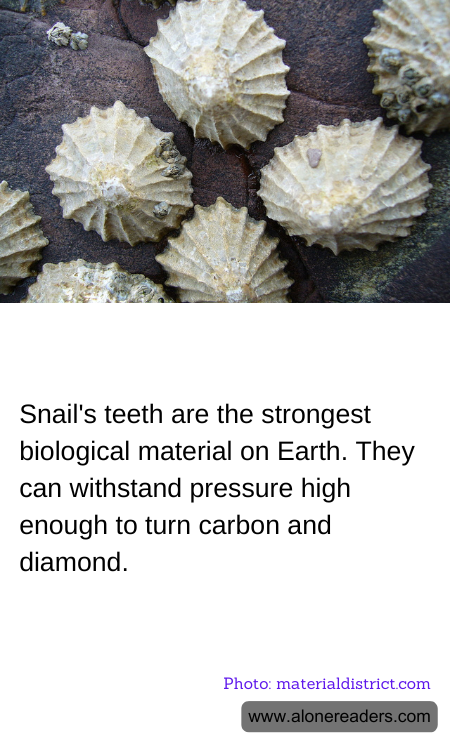
In the fascinating world of biology, snails are often overlooked as simple, slow-moving creatures. However, recent scientific discoveries have revealed that these humble mollusks possess an extraordinary feature: their teeth are made of the strongest biological material known to man. This remarkable finding has not only captivated scientists but also sparked interest across various fields, from materials science to engineering.
The teeth in question belong to a specific type of snail known as the limpet. Limpets are marine snails that cling to rocks in the intertidal zones of oceans. To feed, they scrape algae off the rocks using a specialized tongue-like organ called a radula, which is covered with rows of tiny teeth. It is these teeth that have been found to possess incredible strength and durability. Composed primarily of a mineral called goethite, the teeth of limpets are structured in a way that allows them to withstand immense pressure. In fact, they can endure forces so great that they could theoretically turn carbon into diamond, a process that requires extreme conditions.
The secret to the strength of limpet teeth lies in their unique composition and structure. Goethite, an iron-based mineral, forms in tightly packed fibers within the teeth. These fibers are arranged in a way that maximizes their strength, allowing them to resist wear and tear even under the harsh conditions of the ocean. This natural design is so effective that it has inspired scientists to explore new ways of creating synthetic materials that mimic the structure of limpet teeth for use in various applications, such as in the development of stronger, more durable materials for construction and manufacturing.
The discovery of the strength of limpet teeth not only highlights the incredible capabilities of nature but also underscores the potential for biomimicry in advancing human technology. By studying and emulating the natural designs found in the animal kingdom, researchers hope to develop new materials that are both strong and sustainable. This approach could lead to innovations in industries ranging from aerospace to medical devices, where the demand for lightweight yet durable materials is ever-growing.
In conclusion, the revelation that snail teeth are the strongest biological material on Earth is a testament to the wonders of nature and the untapped potential it holds. As scientists continue to explore the intricacies of the natural world, discoveries like these remind us of the ingenuity and resilience inherent in even the most unassuming creatures. The limpet's teeth, with their unparalleled strength, serve as a powerful example of how nature can inspire and inform the future of human innovation.
