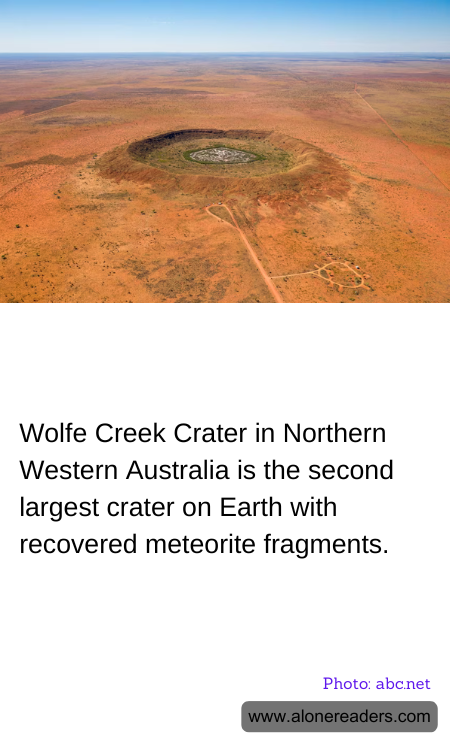
Nestled in the remote expanse of Northern Western Australia lies a geological marvel that has intrigued scientists and adventurers alike: the Wolfe Creek Crater. This awe-inspiring natural formation is recognized as the second largest crater on Earth where meteorite fragments have been recovered, offering a unique glimpse into the cosmic events that have shaped our planet.
The Wolfe Creek Crater, known as "Kandimalal" to the local Djaru Aboriginal people, is a testament to the powerful forces of the universe. It was formed approximately 300,000 years ago when a meteorite, estimated to weigh around 50,000 tonnes, hurtled through the Earth's atmosphere and collided with the surface at an incredible speed. The impact created a massive depression, measuring about 880 meters in diameter and 60 meters deep, making it a significant landmark in the vast desert landscape.
What makes Wolfe Creek Crater particularly fascinating is the presence of meteorite fragments that have been recovered from the site. These fragments provide invaluable insights into the composition of the meteorite and, by extension, the materials that exist beyond our planet. The discovery of these fragments has allowed scientists to study the mineralogy and isotopic compositions, contributing to our understanding of the solar system's history and the processes that govern planetary formation.
The crater's remote location, about 150 kilometers south of Halls Creek, adds to its allure. Visitors who make the journey are rewarded with a breathtaking view of the crater's rim, which rises dramatically from the flat desert floor. The surrounding area is rich in biodiversity, with a variety of plant and animal species adapted to the harsh conditions of the Australian outback. This unique ecosystem offers a stark contrast to the barren appearance of the crater itself, highlighting the resilience of life in extreme environments.
For the Djaru people, Wolfe Creek Crater holds cultural significance and is woven into their Dreamtime stories. According to Aboriginal legend, the crater was formed when a rainbow serpent emerged from the ground, creating the circular depression. This cultural narrative adds a layer of mystique to the site, blending scientific curiosity with indigenous heritage.
Today, Wolfe Creek Crater is a protected area within the Wolfe Creek Meteorite Crater National Park, attracting tourists, researchers, and nature enthusiasts from around the world. The park offers camping facilities and walking trails, allowing visitors to explore the crater and its surroundings at their own pace. Whether viewed from the ground or from above, the crater's sheer size and symmetry are a humbling reminder of the Earth's dynamic history and the cosmic events that continue to shape our world.
In conclusion, Wolfe Creek Crater is not just a geological wonder but a symbol of the interconnectedness of science, culture, and nature. Its status as the second largest crater with recovered meteorite fragments makes it a site of global significance, inviting us to ponder the mysteries of the universe and our place within it.
