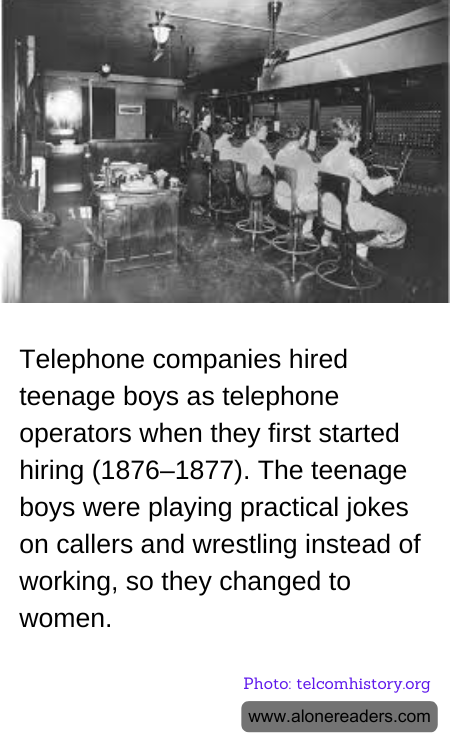
In the late 19th century, the telephone was a groundbreaking invention that promised to revolutionize communication. As telephone companies began to establish their networks, they faced the challenge of staffing their switchboards. Initially, these companies turned to teenage boys to fill the role of telephone operators. The decision seemed logical at the time, as boys were already employed in various messenger and delivery roles, and it was assumed they would adapt well to the new technology.
However, the reality of employing teenage boys as telephone operators quickly proved problematic. The boys, full of youthful exuberance and mischief, often found themselves distracted from their duties. Instead of diligently connecting calls, they engaged in practical jokes on unsuspecting callers. These pranks ranged from harmless antics to more disruptive behavior, which frustrated customers and disrupted the fledgling telephone service. Additionally, the boys were known to engage in wrestling matches and other horseplay during work hours, further diminishing their productivity and reliability.
The telephone companies soon realized that the behavior of their young male operators was not conducive to the professional environment they hoped to cultivate. The need for a more disciplined and courteous workforce became apparent. In response, companies began to hire women as telephone operators. This shift marked a significant change in the industry and had lasting implications for the role of women in the workforce.
Women were perceived as more patient, polite, and attentive to detail, qualities that were highly valued in the role of a telephone operator. Their presence brought a level of professionalism and efficiency that had been lacking. The transition to female operators not only improved the quality of service but also opened up new employment opportunities for women at a time when their participation in the workforce was limited.
The success of women in these roles helped to challenge prevailing gender norms and demonstrated their capability in professional settings. This change laid the groundwork for the increasing involvement of women in various industries throughout the 20th century. The decision to replace teenage boys with women as telephone operators was not just a practical solution to an immediate problem but also a pivotal moment in the history of gender and labor.
In retrospect, the initial hiring of teenage boys as telephone operators serves as an intriguing footnote in the history of telecommunications. It highlights the growing pains of a new industry and the evolving understanding of workforce dynamics. The eventual shift to female operators not only improved the service but also contributed to broader social changes, illustrating how technological advancements can influence societal roles and expectations.
