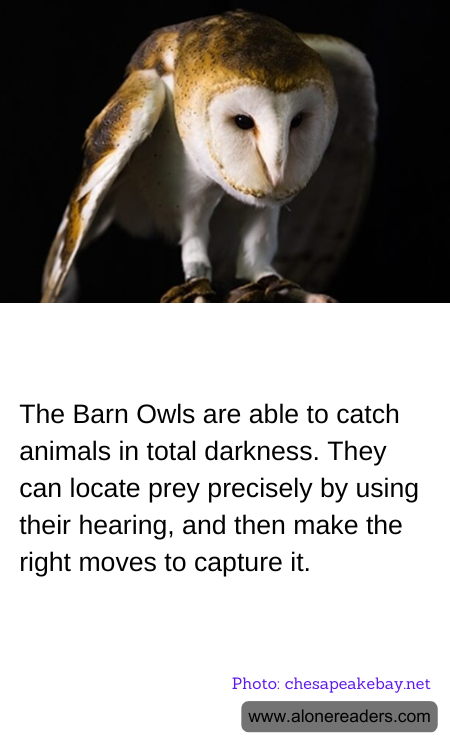
In the stillness of the night, when most creatures are enveloped in darkness, the barn owl emerges as a master of the nocturnal hunt. This remarkable bird has evolved to thrive in conditions where visibility is virtually nonexistent, relying on its extraordinary hearing to locate and capture prey with astonishing precision.
Barn owls are equipped with a unique set of adaptations that make them formidable hunters in the dark. Their facial disc, a concave arrangement of feathers, functions much like a satellite dish, channeling sound toward their ears. This adaptation allows them to detect even the faintest rustle of a mouse or the subtle scurrying of a vole beneath a blanket of leaves or snow. The asymmetrical placement of their ears further enhances their auditory prowess, enabling them to pinpoint the exact location of their prey in three-dimensional space.
Once a barn owl has zeroed in on its target, it executes a silent and calculated approach. Unlike many other birds, barn owls possess specialized feathers that muffle the sound of their flight. This stealthy adaptation ensures that their prey remains unaware of the impending danger until it is too late. As the owl swoops down, it makes minute adjustments to its trajectory, guided solely by the sounds it perceives. This ability to hunt by sound alone is a testament to the owl's finely tuned sensory system.
The barn owl's hunting technique is not only a marvel of nature but also a critical component of its survival strategy. By relying on sound rather than sight, barn owls can hunt effectively in complete darkness, giving them access to a wider range of prey and reducing competition with other predators that depend on vision. This nocturnal advantage has allowed barn owls to inhabit diverse environments, from open fields to dense forests, and even urban areas where they help control rodent populations.
In addition to their impressive hunting skills, barn owls play a vital role in maintaining ecological balance. By preying on small mammals, they help regulate populations that might otherwise grow unchecked, impacting crops and spreading disease. Their presence is a natural form of pest control, benefiting both agriculture and human health.
The barn owl's ability to hunt in total darkness is a fascinating example of nature's ingenuity. Through a combination of acute hearing, silent flight, and precise movements, these birds have mastered the art of nocturnal predation. As we continue to study and appreciate these remarkable creatures, we gain a deeper understanding of the complex and interconnected world we share with them. Whether glimpsed in the wild or admired from afar, the barn owl remains a symbol of the mysteries and wonders of the natural world.
