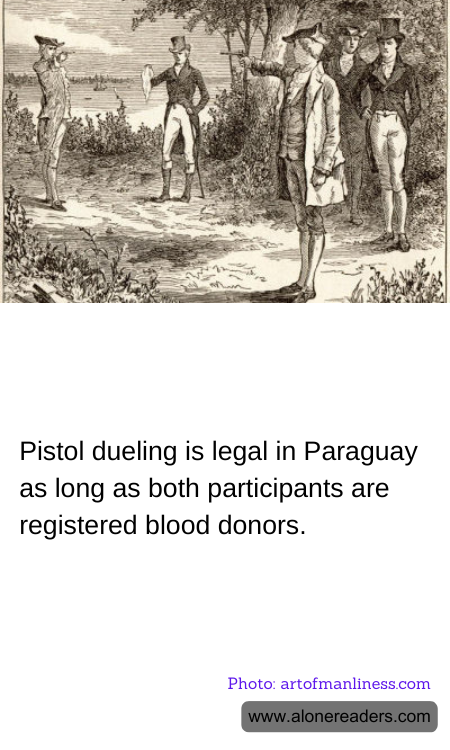
In the realm of unusual laws and traditions, Paraguay holds a unique place with its regulation on pistol dueling. While the practice of dueling has long been outlawed in most parts of the world due to its dangerous and often fatal nature, Paraguay stands out with a peculiar legal exception: pistol dueling is permissible, provided both participants are registered blood donors.
This intriguing law, which seems to straddle the line between historical tradition and modern legal frameworks, reflects a fascinating blend of cultural heritage and contemporary societal values. The requirement for duelists to be registered blood donors introduces an element of civic responsibility into what is otherwise a potentially lethal confrontation. It suggests an underlying message that while individuals may choose to engage in personal combat, they must also contribute positively to society by being prepared to save lives through blood donation.
The origins of this law are somewhat shrouded in mystery, but it likely harks back to a time when dueling was a common method for resolving disputes of honor. In the 19th and early 20th centuries, dueling was a widespread practice among the upper classes in many countries, considered a gentlemanly way to settle grievances. However, as societies evolved and the value of human life became more pronounced, such practices were largely abolished. Paraguay's retention of this law, albeit with the blood donor stipulation, may be seen as a nod to its historical roots while acknowledging modern ethical standards.
Despite its legality, pistol dueling in Paraguay is not a common occurrence. The law is more of a historical curiosity than a practical guideline for conflict resolution in contemporary society. The rarity of such duels can be attributed to the widespread recognition of the dangers involved and the availability of more peaceful and constructive means of resolving disputes. Moreover, the legal and social consequences of engaging in a duel, even if technically permissible, act as significant deterrents.
The requirement for duelists to be blood donors adds an interesting layer to the discussion about personal responsibility and societal contribution. It raises questions about the balance between individual rights and communal obligations. By mandating that potential duelists contribute to the public good, the law implicitly encourages a sense of community and mutual support, even in the context of personal disagreements.
In conclusion, while the notion of legal pistol dueling in Paraguay might initially seem anachronistic, it serves as a fascinating example of how laws can reflect both historical traditions and contemporary values. The stipulation that duelists must be registered blood donors underscores the importance of civic duty and the value of life, even in the context of a practice as archaic as dueling. As such, it remains a curious but thought-provoking aspect of Paraguayan legal culture, inviting reflection on the ways in which societies balance tradition with progress.
