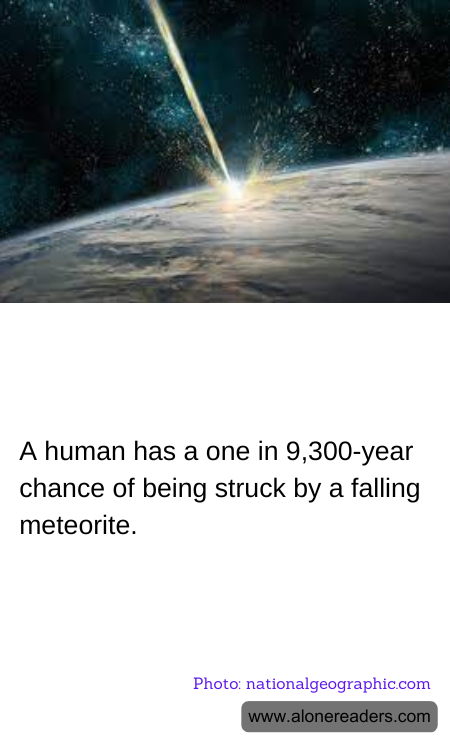
The universe is a vast and mysterious place, filled with countless celestial bodies moving through space. Among these are meteorites, which are fragments of asteroids or comets that survive their fiery journey through Earth's atmosphere and land on our planet's surface. While the idea of a meteorite striking a person might sound like the plot of a science fiction movie, the odds of such an event are surprisingly low. In fact, a human has a one in 9,300-year chance of being struck by a falling meteorite.
To put this into perspective, consider the sheer number of meteorites that enter Earth's atmosphere each year. Scientists estimate that around 17 meteors enter the Earth's atmosphere every day, but the vast majority of these burn up before reaching the ground. Those that do make it through are often small and land in uninhabited areas, such as oceans or remote wilderness. The likelihood of a meteorite hitting a person is therefore incredibly rare, akin to winning a cosmic lottery.
Despite the low odds, there have been a few documented cases of meteorites striking humans. One of the most famous incidents occurred in 1954 when Ann Hodges, a resident of Alabama, was struck by a meteorite that crashed through her roof and hit her while she was napping on her couch. Remarkably, she survived with only minor injuries, but her story remains a testament to the rarity of such occurrences.
The fascination with meteorites extends beyond their potential to strike humans. These space rocks provide valuable insights into the history and composition of our solar system. Scientists study meteorites to learn about the early conditions of the solar system and the processes that led to the formation of planets. Each meteorite that lands on Earth is a piece of cosmic history, offering clues about the universe's past.
For those concerned about the possibility of a meteorite strike, it's worth noting that the odds are far lower than many other everyday risks. For example, the chances of being struck by lightning are significantly higher, yet most people go about their daily lives without fear of such an event. The rarity of meteorite strikes should be a source of comfort rather than concern, reminding us of the vastness of space and the small role we play in the cosmic dance of celestial bodies.
In conclusion, while the idea of being struck by a meteorite captures the imagination, the reality is that such events are exceedingly rare. The one in 9,300-year chance of a human being hit by a meteorite underscores the improbability of this cosmic occurrence. Instead of worrying about meteorites, we can marvel at their scientific significance and the stories they tell about the universe. As we gaze up at the night sky, we can appreciate the beauty and mystery of the cosmos, knowing that the odds are in our favor.
