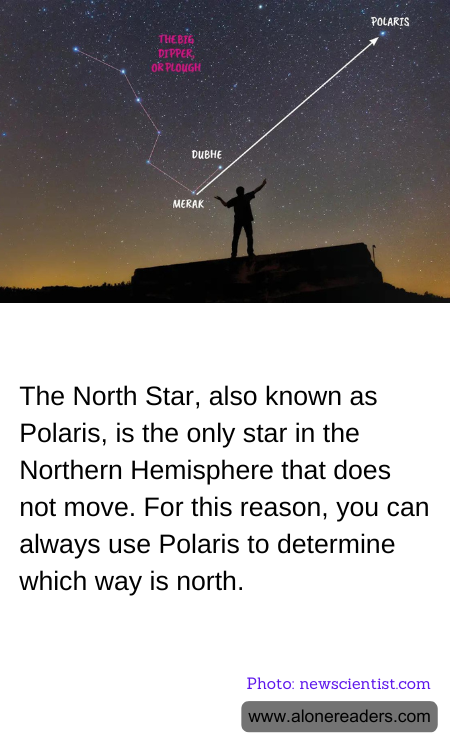
In the vast expanse of the night sky, where countless stars twinkle and shift, one celestial body stands as a steadfast guide: the North Star, also known as Polaris. Unlike its stellar companions, Polaris holds a unique position in the Northern Hemisphere's sky, remaining nearly stationary while other stars appear to dance around it. This unwavering presence makes Polaris an invaluable tool for navigation, allowing travelers and explorers to determine true north with remarkable accuracy.
Polaris is situated almost directly above the Earth's North Pole, which is why it appears to remain fixed in the sky. As the Earth rotates on its axis, the stars seem to move in circular paths around the celestial poles. However, because Polaris is so close to the north celestial pole, it remains in virtually the same spot, providing a reliable point of reference. This characteristic has made Polaris a crucial navigational aid for centuries, guiding sailors across vast oceans and helping lost wanderers find their way.
Finding Polaris is relatively simple, even for novice stargazers. It is part of the constellation Ursa Minor, commonly known as the Little Dipper. The two stars at the end of the bowl of the Big Dipper, part of the constellation Ursa Major, point directly to Polaris. By locating these guide stars, one can easily identify the North Star and, consequently, determine the direction of true north. This method of celestial navigation has been passed down through generations, a testament to its enduring reliability.
The significance of Polaris extends beyond its practical applications. It has inspired countless myths and stories across different cultures, symbolizing constancy and guidance. For the ancient Egyptians, it was associated with the goddess Taweret, while in Norse mythology, it was linked to the god Odin. These cultural connections highlight the star's role not only as a navigational beacon but also as a symbol of hope and direction.
In today's world, where technology often overshadows traditional methods, the North Star remains a powerful reminder of our connection to the natural world. While GPS and digital compasses have become the norm, the ability to navigate using the stars is a skill that fosters a deeper appreciation for the universe and our place within it. Polaris, with its unwavering presence, continues to guide those who seek its light, offering a sense of direction in both a literal and metaphorical sense.
In conclusion, Polaris is more than just a star; it is a celestial anchor in the ever-changing night sky. Its steadfast position has made it an essential tool for navigation and a symbol of guidance throughout history. Whether you're an adventurer seeking your way or simply a stargazer marveling at the night sky, the North Star remains a constant companion, illuminating the path to true north.
