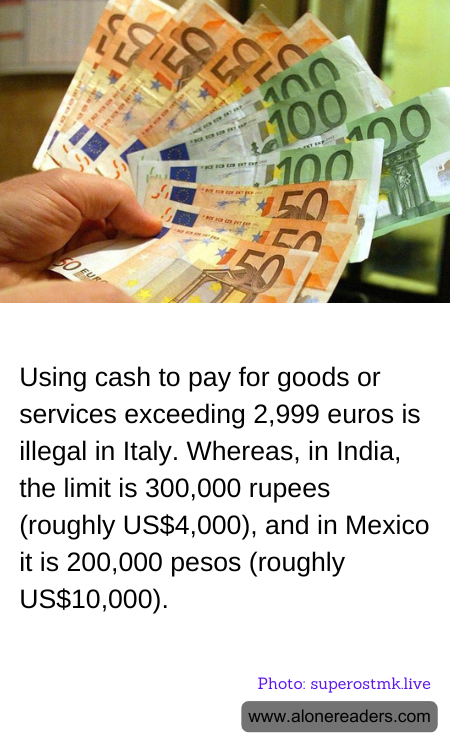
In today's global economy, the use of cash for transactions remains a common practice, yet the regulations governing cash payments vary significantly across countries. Italy, India, and Mexico provide interesting examples of how different nations approach the regulation of cash transactions, each setting distinct limits to curb illegal activities such as money laundering and tax evasion.
In Italy, the use of cash for transactions exceeding 2,999 euros is illegal. This regulation is part of a broader effort by the Italian government to combat tax evasion and promote transparency in financial dealings. By limiting cash transactions, Italy aims to encourage the use of traceable payment methods, such as credit cards and bank transfers, which provide a clearer audit trail for financial authorities. This measure is particularly significant in a country where tax evasion has historically been a challenge, and it reflects a broader European trend towards reducing the reliance on cash.
India, on the other hand, has set its cash transaction limit at 300,000 rupees, which is approximately US$4,000. This regulation was introduced as part of a series of reforms aimed at curbing black money and promoting a digital economy. The Indian government has been actively encouraging its citizens to adopt digital payment methods, which are seen as more secure and efficient. The demonetization initiative in 2016, which saw the withdrawal of high-denomination currency notes, was a bold step in this direction. By imposing a limit on cash transactions, India seeks to reduce the circulation of unaccounted money and increase tax compliance.
In Mexico, the cash transaction limit is set at 200,000 pesos, roughly equivalent to US$10,000. This relatively higher threshold reflects the country's economic context and the prevalent use of cash in everyday transactions. However, like Italy and India, Mexico's regulation is part of an effort to combat money laundering and enhance financial transparency. The Mexican government has been working to strengthen its financial system and improve tax collection, and limiting large cash transactions is a key component of this strategy.
These varying limits on cash transactions highlight the different approaches countries take to address similar economic challenges. While the specific thresholds differ, the underlying goal remains consistent: to reduce the potential for illegal financial activities and promote a more transparent and accountable economic system. As digital payment technologies continue to evolve, it is likely that more countries will adopt similar measures, further reducing the reliance on cash and enhancing the integrity of global financial systems.
For individuals and businesses operating internationally, understanding these regulations is crucial. Adhering to the legal limits on cash transactions not only ensures compliance with local laws but also contributes to the broader effort to create a more transparent and equitable global economy. As countries continue to refine their financial regulations, the trend towards limiting cash transactions is likely to persist, reflecting a growing consensus on the benefits of a more traceable and accountable financial system.
