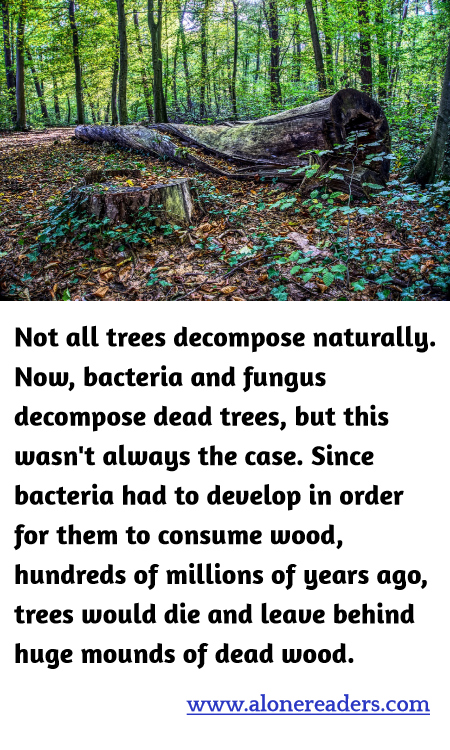
Before bacteria and fungi evolved the ability to decompose wood, fallen trees accumulated on the Earth's surface, creating massive, undecayed piles of timber. This phenomenon occurred primarily during the Carboniferous period, approximately 359 to 299 million years ago. During this era, vast forests dominated the landscape, composed largely of primitive tree species such as Lepidodendron and Sigillaria, which had thick, bark-like structures and shallow root systems.
These ancient trees, unlike their modern descendants, contained a high amount of lignin, a complex organic polymer that provides rigidity to the cell walls of plants. Lignin was particularly resistant to decay, and the microbes and fungi capable of breaking it down had not yet evolved sophisticated enough enzymes to handle this tough material. As a result, when these trees died, their trunks and branches simply amassed, forming peat bogs—thick, dense layers of organic material.
The undecomposed plant material eventually transformed under heat and pressure over millions of years, contributing significantly to the formation of coal. This accumulation of vast coal deposits from this period is one of the reasons the Carboniferous period is so named—after carbon, the primary element in coal.
The natural process of wood decay changed dramatically with the evolution of white rot fungi and other decomposing organisms. These organisms developed enzymes capable of breaking down lignin and cellulose, the primary components of wood. This evolutionary advancement not only helped clear vast tracts of fallen wood, thus transforming the landscape, but also played a crucial role in the carbon cycle, breaking down dead organic matter and releasing carbon dioxide back into the atmosphere.
The development of these decay processes is pivotal in understanding the Earth’s geological and biological history. It shows how life adapts over time and how these adaptations can have long-lasting impacts on the planet’s ecosystem and climate. This intricate connection between biological evolution and geological transformations highlights the dynamic nature of our planet, where even the smallest biological changes can lead to profound environmental shifts.
