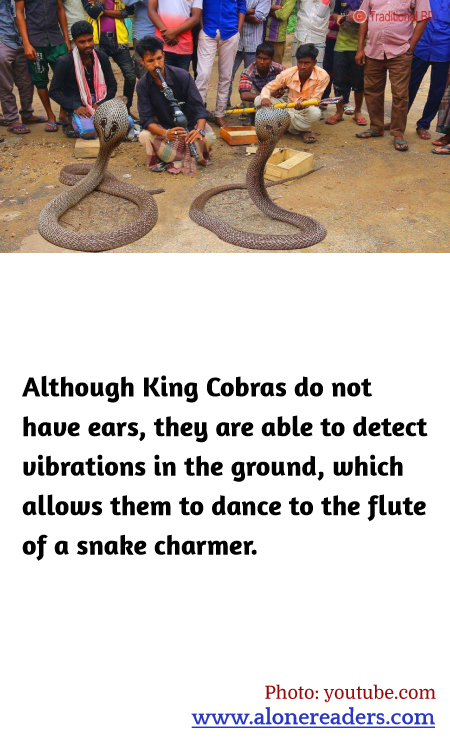
King Cobras are among the most fascinating creatures in the animal kingdom, primarily because of their size, venom potency, and unique behaviors. One of the most intriguing aspects of king cobras is their ability to respond to the snake charmer's flute despite lacking external ears. Contrary to popular belief, the snakes are not dancing to the melody of the music but are instead reacting to the physical movements of the flute and the vibrations it creates in the air and ground.
Snakes, including king cobras, perceive their environment through a variety of senses. Being deaf to airborne sounds, they rely heavily on vibrations to navigate and interact with their surroundings. Their jawbones are sensitive and can pick up vibrations from the ground, which are then transmitted to the cochlea, an organ similar to the human inner ear. Additionally, the king cobra's ability to sense vibrations is supported by its keen sensitivity to changes in air pressure, which allows it to detect any nearby movements.
When a snake charmer plays his flute, the king cobra feels the vibrations and responds defensively by rearing up. The movement of the flute compels the snake to focus on it, mistaking it as a potential threat, which is why the snake appears to 'dance.' In reality, these movements are defensive postures, instinctively adopted by the snake to intimidate and track the perceived threat—qualities essential for the survival of this apex predator in the wild.
This behavior underscores not only the adaptability of king cobras but also their role in human culture, particularly in South and Southeast Asia where snake charming has been practiced for centuries. The spectacle of a 'dancing' king cobra remains a compelling symbol in the cultural mosaic of this region, highlighting a complex interplay between human culture and wildlife.
Understanding these dynamics highlights the importance of respecting and preserving wildlife while acknowledging cultural practices that have fascinated human imagination for ages. The king cobra continues to be a creature of mystery and reverence, a magnificent example of nature's intricacy and an important species in the ecosystems they inhabit.
