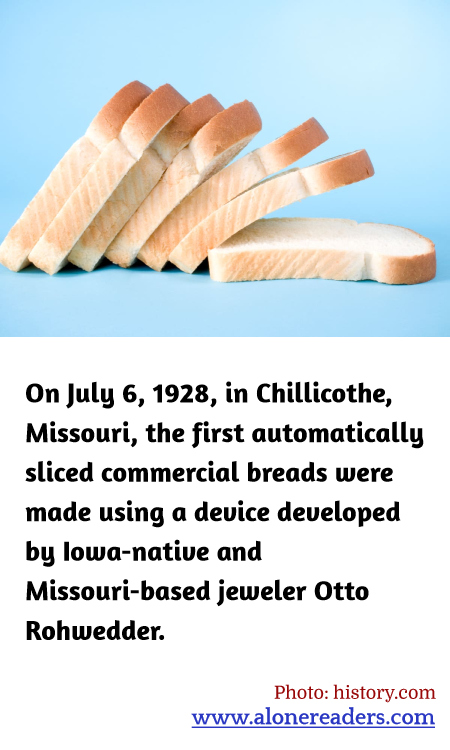
On July 6, 1928, a simple yet revolutionary advancement in the culinary world emerged from Chillicothe, Missouri, fundamentally altering the way people consumed bread. This change was brought forth by the invention of the first automatic bread-slicing machine, a development by Otto Rohwedder, an Iowa native and jeweler by trade, who had settled in Missouri. Rohwedder's invention not only represented a significant technological leap, but it also marked a pivotal moment in the history of consumer convenience and food processing.
Rohwedder's journey to this breakthrough was not without its challenges. His initial ideas and designs, dating back to 1912, were met with skepticism and resistance from bakers, who were unconvinced that a machine could slice bread better than a skilled human. Moreover, there were concerns that pre-sliced bread would go stale faster. Persistent, Rohwedder addressed these issues by designing his machine to also wrap the bread immediately after slicing, thereby preserving its freshness.
The first bread-slicing machine was installed at the Chillicothe Baking Company of Chillicothe, Missouri, and the first loaves of sliced bread were produced on July 6, 1928. The product, named “Kleen Maid Sliced Bread,” proved to be an instant success. The convenience of pre-sliced bread perfectly matched the pace and needs of modern twentieth-century life, leading to widespread acceptance and demand. The phrase "the greatest thing since sliced bread" soon entered common parlance, reflecting the public's admiration for what seemed to be a simple yet transformative innovation.
The impact of Rohwedder's invention extended beyond just consumer convenience. It triggered changes in the baking industry, prompted innovations in packaging, and influenced eating habits across the globe. The ability to produce uniformly sliced bread on a mass scale allowed for the ease of spreadable toppings and more consistent toasting, contributing to new food products and recipes. This innovation not only highlighted the importance of efficiency and precision in manufacturing but also underscored the potential of technology to improve daily life.
Thus, the advent of automatically sliced commercial bread stands as a testament to human ingenuity and the relentless pursuit of progress in making everyday tasks simpler. Otto Rohwedder's invention, first realized in a small town in Missouri, remains a hallmark in the history of food processing technology, forever changing our interaction with one of the most basic staples of diets worldwide.
