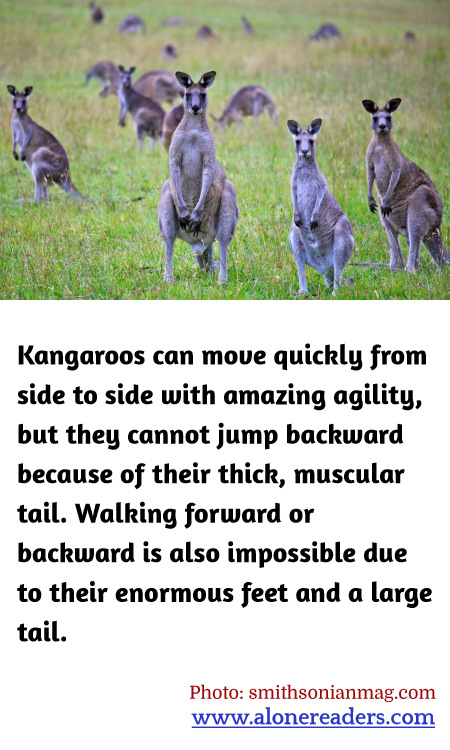
Kangaroos are one of Australia's most iconic and fascinating marsupials, known for their unique mode of locomotion and distinctive body structure which plays a crucial role in their movement abilities and limitations. These intriguing creatures have developed a remarkable ability to hop at high speeds across the vast Australian landscape, an evolutionary adaptation that serves them well in outrunning predators and traversing long distances in search of food and water. However, this adaptation comes with certain restrictions, notably their inability to move backwards.
The anatomy of a kangaroo is highly specialized for forward movement. The kangaroo's large, powerful hind legs are not only capable of propelling them forward at speeds that can exceed 35 miles per hour but also allow for impressive lateral (side-to-side) agility that is crucial when dodging obstacles or potential threats. However, these same evolutionary adaptations that aid in swift and agile forward movement prevent kangaroos from moving backward. The primary reason for this limitation is their thick, muscular tail which acts as a third leg, providing balance and support while hopping. This tail is so strong and rigid that it makes backward movement impossible.
Furthermore, kangaroos have large feet that are highly adapted for forward hopping with elongated tendons that store kinetic energy like a spring, helping to propel them forward efficiently. These feet, while excellent for bounding at great speeds and covering large distances with each hop, are not conducive to walking or hopping backward. Similarly, backward movement is hindered by the positioning and structure of their legs and pelvis, which are optimized almost exclusively for forward motion.
Despite these restrictions, kangaroos' forward hopping is incredibly energy-efficient. This efficiency is vital in the often harsh, arid climate of the Australian outback, where food and water can be scarce and conserving energy becomes critical for survival. The ability to quickly move side to side allows kangaroos to maintain agility and maneuverability, which is crucial, especially when they need to swiftly change directions to escape from predators.
In conclusion, while kangaroos are restricted in certain movements such as walking and hopping backwards due to their specialized anatomy, these limitations are a trade-off for the remarkable adaptations that support their survival and efficiency in the wild. Their evolutionary journey has thus shaped them into the incredible hoppers that are synonymous with the Australian natural landscape, demonstrating the complex balance between anatomical form and functional need in evolution.
