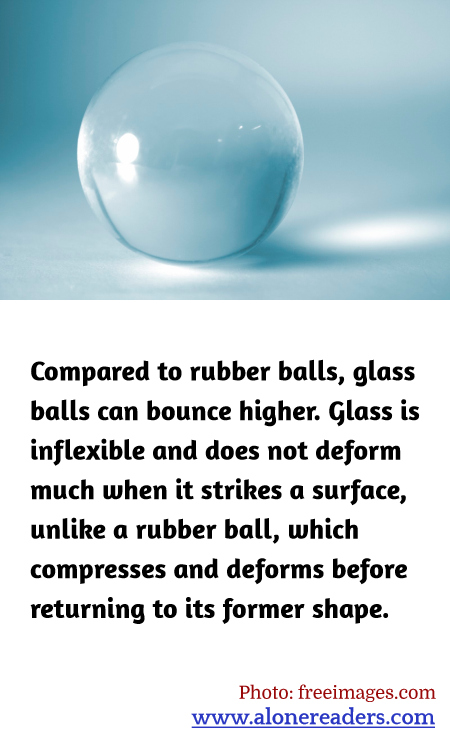
The idea that glass balls can bounce higher than rubber balls seems counterintuitive at first, given the everyday experience with rubber's elasticity. However, the science behind how different materials bounce illuminates why this might be the case in certain conditions. When a ball bounces, it converts kinetic energy into potential energy and vice versa. A key factor in this energy conversion is how the material of the ball reacts upon impact.
Rubber balls, widely recognized for their bounciness, owe their high rebound rates to their elasticity. When a rubber ball hits a surface, it compresses and deforms, storing potential energy during the brief moment of compression before swiftly resuming its shape and converting the potential energy back into kinetic energy, propelling the ball upward.
Glass, contrastingly, is a much more rigid material and typically fractures under stress where a rubber ball would deform. The secret to a glass ball’s ability to bounce - possibly even higher than a rubber ball under the right circumstances - lies in its rigidity and the minimal energy lost to deformation. In a perfectly ideal condition where the glass does not break, a glass ball can theoretically bounce higher because it deforms less and thus loses less energy during the collision.
The surface on which the balls are dropped is just as crucial in determining the height of the bounce. A hard surface like concrete may lend more energy back to a rigid glass ball compared to a rubber ball, which loses more energy conforming to the surface texture during its deformation. On softer surfaces, rubber balls might outperform glass due to their ability to deform and grip the surface, gaining additional traction and push for a higher bounce.
Additionally, the quality of the material, the precise composition of the glass or rubber, and the exact environmental conditions like temperature and surface roughness will significantly affect the outcome of any bounce tests. Techniques in manufacturing can also play a role, such as tempering glass to enhance its strength and durability, potentially allowing a glass ball to sustain repeated impacts without breaking.
Indeed, while glass balls might be able to achieve higher bounce heights in ideal, controlled environments compared to rubber balls, practical applications typically favor rubber due to its versatility and durability. Understanding the specific behaviors of different materials under various conditions is crucial in physics and engineering, providing insight that goes well beyond a simple bounce.
