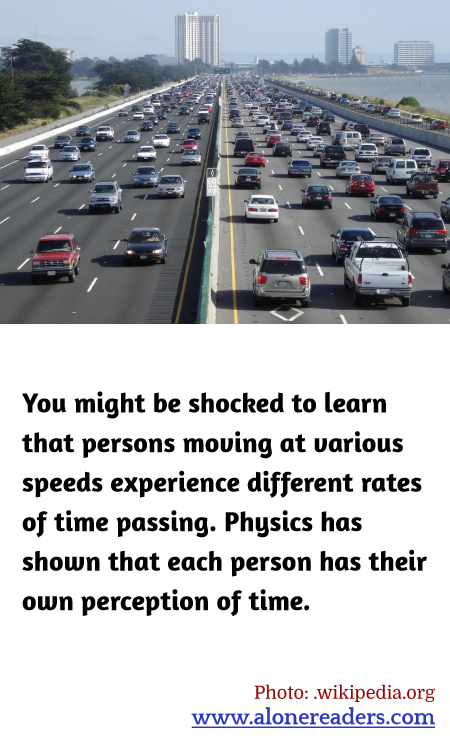
Time perception isn’t just a matter of how busy or bored we are; it is deeply entwined with the laws of physics, specifically the theory of relativity. Einstein’s groundbreaking work in the early 20th century revealed that time is not as constant as it once seemed. It varies not only by velocity but also by gravity. According to his theory, the faster one moves, the slower time passes relative to someone at rest. This phenomenon, known as time dilation, has astounding implications, especially at speeds close to the speed of light.
Imagine two astronauts — one traveling in a high-speed rocket and the other remaining on Earth. The astronaut in the rocket, moving at a significant fraction of the speed of light, would age more slowly compared to their counterpart left behind on our planet. This isn’t mere science fiction; it has been experimentally verified using precise atomic clocks in high-speed jets, which show minuscule, yet consistent, discrepancies when compared to clocks on the ground.
However, velocity isn’t the only factor influencing the passage of time. Gravity plays a significant role too. Einstein’s general theory of relativity explains that time runs slower in stronger gravitational fields. This means time passes ever so slightly faster on a mountain top than it does at sea level. These effects, while tiny, are real and measurable with today's advanced technology, such as GPS satellites, which must adjust for both the effects of velocity and the weaker gravitational pull far from Earth's surface to provide accurate positioning information.
Time is perceived differently even in our everyday experiences, though these variations are more a psychological phenomenon than a relativistic one. Factors such as age, attention, and emotional state all influence how we perceive the passage of time. Children often feel time crawling during schooling hours or waiting periods, while adults might be astonished at how swiftly years seem to pass. Emotionally charged moments tend to feel longer in memory, though they might rush by in real time.
Thus, time, as it turns out, is not an absolute measure across the universe but varies depending on a variety of factors ranging from speed to gravitational forces, to personal psychological states. These insights challenge the simplicity of ticking clocks and remind us of the complex, intertwined universe we are a part of, where time is not merely a backdrop but an active player in the cosmos. This dynamic nature of time invites wonder and curiosity, pushing both our understanding and imagination to profound depths.
