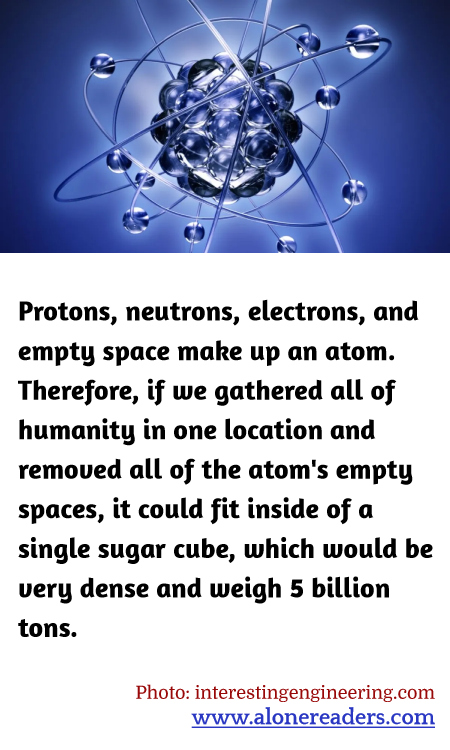
Atoms, the fundamental building blocks of matter, are composed of protons, neutrons, and electrons. Within an atom, protons and neutrons form a dense core known as the nucleus, while electrons whirl around this nucleus at great distances relative to the nucleus’s size. Most of an atom's volume is actually empty space between the nucleus and the electron cloud, which is a concept that counters our everyday understanding of physical matter.
The notion that if all the empty space within atoms were removed, humanity could be compressed into the volume of a sugar cube, highlights the mind-boggling proportion of empty space in matter. While theoretically interesting, practically, removing all the empty space from atoms would require overcoming the fundamental forces of nature, including the electromagnetic force that prevents electrons from collapsing into the nucleus due to their negative charge, which repels from the positively charged protons.
The resulting matter, with all empty space removed, would be an incredibly dense and compact mass. Such a mass, even the size of a sugar cube, containing the essence of all humanity, would indeed weigh about 5 billion tons. This speaks to the nature of nuclear density, which is observed in cosmological phenomena like neutron stars – remnants of supernovae where atoms have been stripped of their empty space, leaving only neutrons.
This profound fact underscores not only the wonder of physical laws but also the theoretical extremes of density and mass. Understanding such extremes provides insights into both the microscopic world of atomic particles and the expansive cosmos, bridging perceptions of size, mass, and space in the universe.
