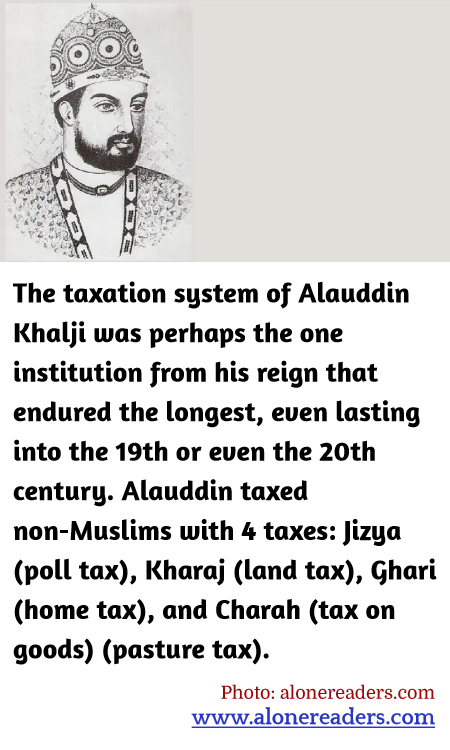
Alauddin Khalji, the Sultan of Delhi from 1296 to 1316, was known for his authoritarian regime and significant military conquests, but it was his taxation system that arguably left a lasting impact, enduring well beyond his reign, potentially influencing policies until the 19th or even 20th centuries. His tax policies were structured to maximize revenue, which he used to consolidate power, sustain his large armies, and administer his expanding empire.
Alauddin implemented a rigorous taxation system particularly focused on non-Muslims, comprising four main taxes: Jizya, Kharaj, Ghari, and Charah. Jizya, the poll tax, was levied on non-Muslims as a form of tribute and a means of enforcing their subordinate status. This tax was not unique to Alauddin’s regime but was a common practice in many Islamic empires as a part of Sharia law. The Kharaj was a land tax which, under Alauddin, was rigorously enforced to ensure that the state extracted considerable revenue from agricultural produce. This was particularly significant in a predominantly agrarian economy like that of medieval India.
Additionally, the Ghari tax was imposed on dwellings, further burdening non-Muslims economically. The Charah tax was levied on pasture lands used by herdsmen, affecting both the agricultural and pastoral sectors. These taxes, while ensuring substantial state revenue, also aimed at regulating and controlling the economic activities of the subjugated populations.
Alauddin Khalji’s tax system was not merely a fiscal mechanism but also a tool of social and political control, aiming to reinforce Islamic dominance and the Sultan’s authority across varied ethnic and religious groups within the empire. The efficiency of his tax collection was supported by a network of officials and strict regulations, which curtailed corruption to an extent but also led to heightened state surveillance and control over the populace.
The longevity of Alauddin Khalji’s taxation principles suggests their effectiveness in generating revenue critical to the empire’s expansion and defense. More so, the endurance of this system highlights its foundational role in the administrative practices of later regimes, indicating its deep-rooted influence in the region’s governance models. This enduring legacy reflects the systematic and calculated approach adopted by Alauddin Khalji, further cementing his place as a pivotal figure in the economic and political history of medieval India. While his policies did have economic motives, they also reflected the broader socio-political contexts of the time, intertwining economic measures with religious and social governance.
