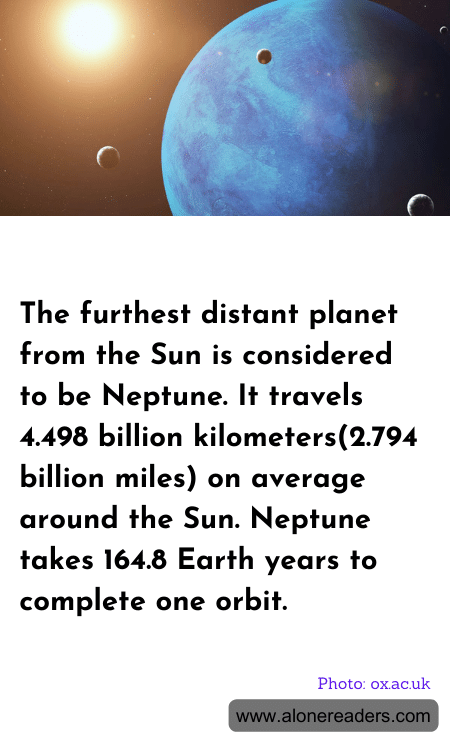
Neptune, the eighth planet from the Sun, holds the title of the most distant planet in our solar system. This distant, blue giant averages a staggering 4.498 billion kilometers (approximately 2.794 billion miles) away from the Sun. Given its colossal orbit, Neptune experiences exceptionally long years; one Neptunian year—the time it takes to complete one orbit around the Sun—equates to about 164.8 Earth years.
Discovered in 1846, Neptune was the first planet located through mathematical predictions rather than through regular observational astronomy. This discovery marked a pivotal moment in the history of astronomy, affirming the power of mathematics in celestial mechanics.
Neptune's composition and atmosphere are primarily made up of hydrogen, helium, water, and silicates, giving it an enchanting deep blue color. This blue hue is due to the absorption of red light by methane in the atmosphere. Despite its serene appearance, Neptune has some of the wildest and most extreme weather in the solar system. It features the fastest winds observed on any planet, which can exceed speeds of 1,200 kilometers per hour (about 745 miles per hour).
Exploration of Neptune has been limited; however, the Voyager 2 spacecraft provided the most in-depth study of the planet in 1989. It gave humanity a close-up view of the planet's atmosphere, rings, moons, and even discovered the "Great Dark Spot,” reminiscent of Jupiter's Great Red Spot.
Understanding Neptune and its environment provides important clues about planet formation and the characteristics of other icy giants in and beyond our solar system. As we continue to develop our capabilities in space travel and technology, future missions may offer even more detailed insights into Neptune’s mysteries. Such exploration could unlock further secrets of the outer solar system, deepening our knowledge of the universe and our place within it.
