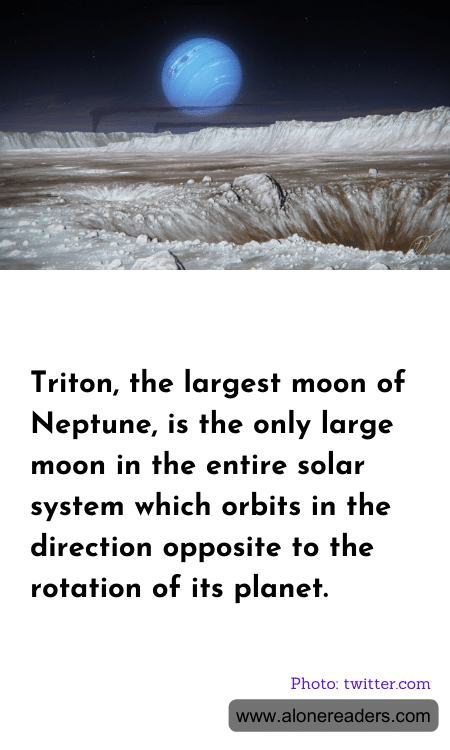
Triton, Neptune's largest moon, stands out in the solar system for its unusual orbital characteristics. Unlike all other large moons, Triton orbits Neptune in a direction opposite to the planet's rotation, a retrograde orbit that has intrigued astronomers and researchers alike. This remarkable feature hints at Triton's tumultuous past and provides insights into its capture by Neptune's gravitational pull.
Triton is not just unique in its orbital pattern; it is also one of the coldest objects in our solar system, with surface temperatures dipping to about -235 degrees Celsius (-391 degrees Fahrenheit). Despite these frigid conditions, Triton exhibits a surprisingly active geological surface, characterized by cryovolcanism – volcanoes that erupt water, ammonia, or methane instead of molten rock. These icy volcanic activities hint at an internal heat source, possibly driven by tidal heating, which occurs as Neptune's massive gravitational force stretches and squeezes the moon.
The moon's surface is relatively young, geologically speaking, with few impact craters. This implies ongoing surface renewal, possibly from cryovolcanic plumes and nitrogen geysers, which eject dark particles and dust into its thin atmosphere, composed mainly of nitrogen with trace amounts of methane. Triton's atmosphere, albeit thin, supports transient, thin clouds of frozen nitrogen. Furthermore, as Triton orbits Neptune, it displays dramatic seasonal changes and bright southern polar caps, likely composed of condensed nitrogen.
Triton's retrograde orbit suggests it was not initially a part of our solar system but a captured object, likely a former Kuiper Belt object dislodged by gravitational disturbances. Its capture into Neptune's orbit might explain the unusual inclination and orbital direction, distinguishing it from typical moons that form from the same disc material as their planets.
The exploration of Triton began with Voyager 2's flyby in 1989, providing most of what is known about Triton today. Its unique features make it a prime candidate for future space missions. Scientists believe that studying Triton can further understanding of the outer solar system's dynamics and evolution, particularly the processes of moon capture and the atmospheric and geological characteristics of icy bodies. As such, Triton remains a fascinating subject in planetary science, promising to reveal more secrets about the natural processes governing our solar system’s outer realms.
