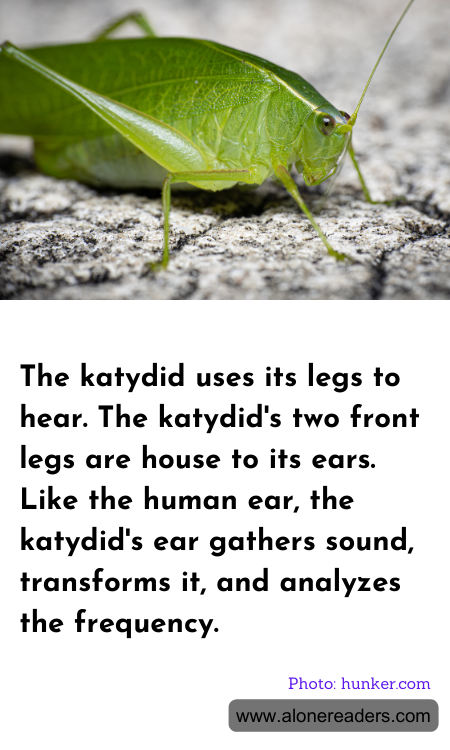
Katydid insects are fascinating creatures, particularly because of their unusual auditory system. Unlike most animals that have ears on their heads, katydids have their ears located on their legs. Specifically, the ears are found on the tibia of their front legs. This unique placement is not just a bizarre trait but a highly functional adaptation that serves them well in their natural habitats.
The hearing organs of katydids are structured with intricacies that allow these insects to detect sounds effectively. Similar to human ears, the katydid’s ears consist of a tympanum, which functions much like a eardrum. This thin membrane vibrates in response to sound waves. Beneath the tympanum, there are sensory cells that are analogous to the hair cells found in human ears, which help in transforming these vibrations into electrical signals that are then processed by the insect's nervous system. This process enables the katydid not only to hear but to discern the frequency and direction of the sounds, an ability crucial for communication and predator avoidance.
The sound-detecting capabilities of katydids are especially important during mating season. Males use acoustic signals to attract females, each species producing a unique song. The ability of female katydids to hear and recognize the specific calls of their male counterparts is critical for reproductive success. Furthermore, being able to hear allows katydids to be vigilant against predators. The auditory range of katydids enables them to detect and react to the subtle noises produced by potential threats, making their hearing organs vital for survival.
Research into the katydid's auditory system not only sheds light on the diversity of sensory adaptations in insects but also has potential implications for human technology. Understanding how these insects can decipher sound directionality and frequency with such a compact sensory system could inspire new advancements in audio engineering and the development of more sophisticated auditory devices.
In conclusion, the katydid’s ability to use their legs to hear is a remarkable example of evolutionary adaptation, showcasing the intricate and diverse ways life evolves to meet the ecological demands of various environments. These insects continue to be subjects of scientific curiosity, not only due to their unique biological features but also because of their potential to influence technological innovation in acoustics.
