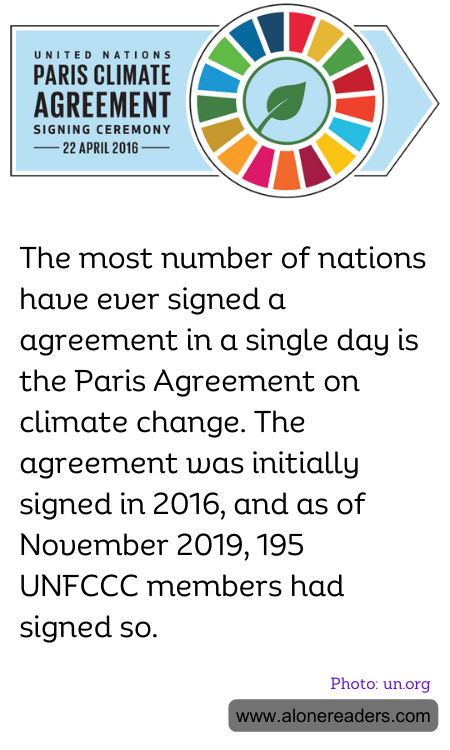
The Paris Agreement, a landmark accord within the realm of international climate policy, holds the record for the most nations signing an agreement on a single day. This pivotal moment occurred on April 22, 2016, coinciding with Earth Day, underscoring the global commitment to environmental stewardship. On that day, 175 countries took the historic step of endorsing the agreement at a ceremony held at the United Nations headquarters in New York, setting a powerful precedent in unified global action against climate change.
The agreement itself emerged from lengthy negotiations during the COP21 summit held in Paris in December 2015, where the consensus was to mitigate global warming by keeping the global temperature rise this century well below 2 degrees Celsius above pre-industrial levels, and to pursue efforts to limit the increase even further to 1.5 degrees Celsius. The deal marked a significant shift in the approach to global climate policy, focusing not only on reducing emissions but also on strengthening the ability of countries to deal with the impacts of climate change.
By November 2019, the participation had expanded, with 195 UNFCCC members having signed the agreement, indicating nearly universal acceptance and commitment. This widespread signature is a reflection of the worldwide recognition of the urgent need to address the climate crisis and the collaborative efforts required to tackle such a complex global issue.
The Paris Agreement is unique not only because of its broad endorsement but also due to its structure and approach. It is designed to be dynamic, with commitments meant to intensify over time. Nations come together every five years to set more ambitious targets and report on their progress. Moreover, the agreement provides a framework for financial, technical, and capacity-building support to help developing countries achieve their climate goals.
The universal backing of the Paris Agreement exemplifies the global acknowledgment that climate change is a critical and pressing challenge that transcends borders, requiring concerted and sustained international cooperation. It stands as a beacon of global unity and a hopeful step toward a sustainable future, demonstrating the world's collective pledge to bequeath a healthier planet to future generations.
