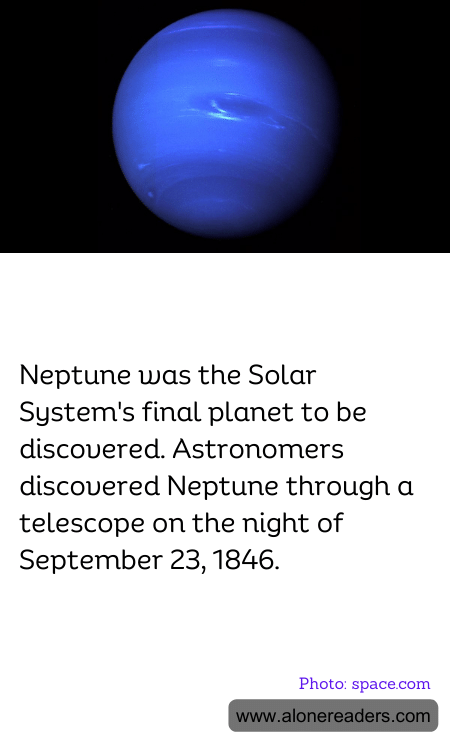
Neptune's discovery is a remarkable tale of prediction and observation intersecting. Before Neptune was ever seen through a telescope, it made its presence known through the peculiar behavior of Uranus, discovered in 1781. Astronomers noticed that Uranus’s orbit was not as predicted by Newton’s laws of motion. This led to the hypothesis that another, yet unseen, planet might be exerting gravitational influence on Uranus.
The mathematical calculations that predicted Neptune's position were independently performed by John Couch Adams and Urbain Le Verrier. Adams, a British mathematician, and Le Verrier, a French astronomer, both concluded that the discrepancies in Uranus's orbit could be accounted for by a planet lying further from the Sun. Despite Adams's communications with the Royal Observatory at Greenwich, his predictions did not immediately lead to a search for the new planet.
Le Verrier sent his calculations to the Berlin Observatory, and the very night Johann Gottfried Galle and his student Heinrich d'Arrest received Le Verrier's predictions, they pointed their telescope to the suggested region of the sky. On September 23, 1846, they observed Neptune, less than a degree away from where Le Verrier had predicted it to be. This discovery stood as a monumental validation of Newtonian mechanics as applied to celestial mechanics.
Neptune is not just a case study in the power of predictive mathematics; it is also a fascinating object in its own right. Located about 30 times farther from the Sun than Earth, Neptune orbits in the remote cold outer reaches of our solar system. It is characterized by its striking blue appearance, due to the absorption of red light by methane in its atmosphere, and is often accompanied visually by its largest moon, Triton, which was discovered just 17 days after Neptune itself.
The discovery of Neptune opened a new frontier in the scientific study of the outer solar system. Its existence hinted at the vastness of space and urged a reconsideration of what may lay beyond the known planets. This event not only underscores the interconnected growth of mathematical physics and observational astronomy but also marks a significant moment in human understanding of the cosmos.
