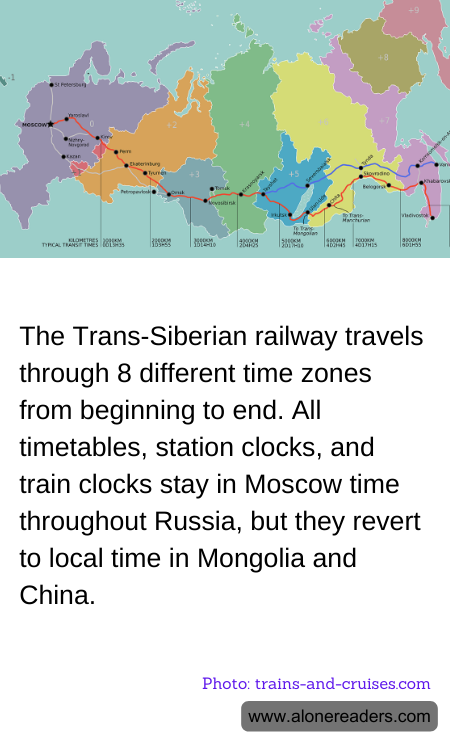
Spanning an impressive 9,289 kilometers, the Trans-Siberian Railway holds the title as the longest railway line in the world. Connecting Moscow in the west to Vladivostok in the east, it crosses a vast expanse of Russia and ventures through eight different time zones. Despite this, the journey through Russia maintains a unique approach to timekeeping—everything runs on Moscow time. This method simplifies the complex task of managing the schedule of trains that traverse such a large and diverse geographical and temporal landscape.
From the moment passengers step onto the train in Moscow until they disembark in Vladivostok, all timetables, station clocks, and train clocks align with the time in the Russian capital, regardless of the local time. This uniformity ensures a seamless operation and avoids confusion among the thousands of passengers who travel along the route daily. It's a practical solution to prevent the complications that could arise from constantly changing the clocks inside the trains and at the stations to match the local time as the train speeds across the country.
However, this synchronization with Moscow time ceases once the train enters Mongolia and later China. Upon crossing these national borders, the railway adheres to the local time zones. This shift is necessary for maintaining international standards and facilitating smoother interactions at local stations, where the alignment with the native timekeeping is crucial for operations and local passenger services.
The continued use of Moscow time across such a vast stretch of domestic railway underlines not only the centralized nature of operations within Russian railways but also highlights an interesting facet of rail travel across large nations. It poses a curious anomaly in the world of international travel, where typically local time rules. Here, in the heart of Russia, Moscow time reigns supreme across thousands of miles, binding the expanse of a nation together, even if just by the clocks.
