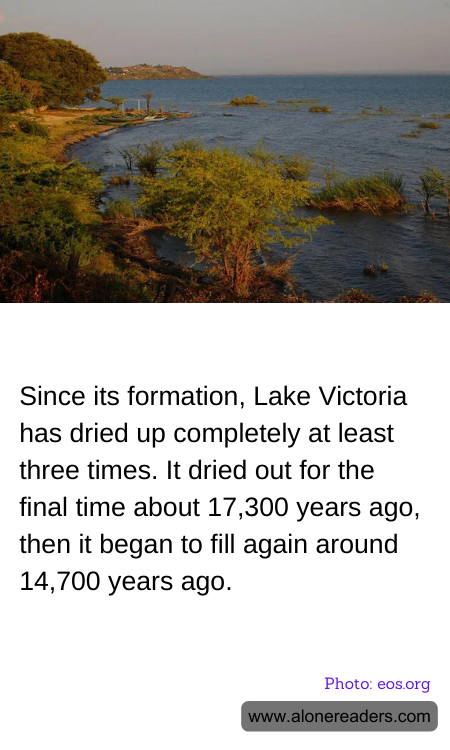
Lake Victoria, one of the African Great Lakes, has a rich geological and ecological history that spans thousands of years. This lake, which is the largest in Africa and the second-largest freshwater lake by surface area in the world, has not always been the vibrant body of water we know today. Remarkably, geological evidence suggests that Lake Victoria has completely dried up at least three times since its formation.
The most recent drying period occurred around 17,300 years ago, during a phase commonly associated with the last glacial period, a time when ice sheets covered much of the Earth's higher latitudes. This climatic event led to drastic changes in rainfall patterns and water levels in lakes across East Africa, culminating in the complete desiccation of Lake Victoria. Such an event would have had significant repercussions on the local ecosystem and biodiversity, leading to the loss of many aquatic species.
Then, approximately 2,600 years later, around 14,700 years ago, the climate began to shift again. Warmer temperatures and increasing rainfall across the region allowed Lake Victoria to begin refilling with water. This refilling marked a crucial turning point in the ecological recovery of the area. As the lake's waters rose, they would have brought new life, enabling the return of many fish species and other aquatic organisms. These species either survived the dry period in refugia or migrated back into the lake from connected riverine systems. The replenishment of Lake Victoria not only restored its aquatic ecosystem but also reestablished it as a critical resource for the surrounding communities in terms of water supply, fishing, and transportation routes.
This cycle of drying and refilling highlights the dynamic nature of Lake Victoria's ecological and climatic history and underscores its resilience. However, it also serves as a poignant reminder of the lake's vulnerability to climatic fluctuations. In recent times, Lake Victoria has faced numerous ecological challenges, including pollution, invasive species, and overfishing, further compounded by the impacts of climate change.
Understanding the historical changes in Lake Victoria, such as its complete drying and subsequent recovery, is crucial for ongoing conservation efforts and for the sustainable management of its natural resources. These insights provide a valuable perspective on how the lake may respond to future climatic shifts and help in formulating strategies to mitigate adverse impacts, ensuring that Lake Victoria remains a vital lifeline for the millions of people who depend on it.
