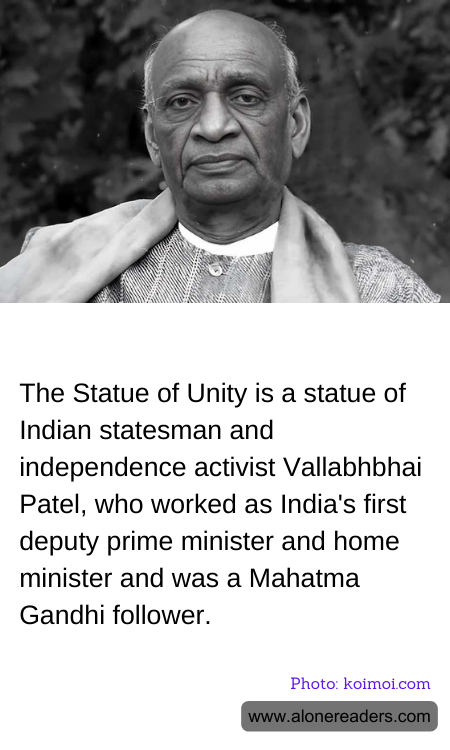
The Statue of Unity stands not only as a monument to Indian statesman Vallabhbhai Patel, known as Sardar Patel, but also as a symbol of unity and peace in India. Erected in the state of Gujarat, it is the tallest statue in the world, reaching a height of 182 meters. Sardar Patel, who served as India's first Deputy Prime Minister and Home Minister, played a pivotal role in the country's struggle for independence and later in the integration of over 560 princely states into the Union of India. His efforts earned him the title 'Iron Man of India,'.
The statue, inaugurated on October 31, 2018, by Prime Minister Narendra Modi, is not just a tribute to Patel's life and legacy but also envisages promoting tourism in the area. Designed by Indian sculptor Ram V. Sutar, the project was part of a broader government initiative to foster national pride and historical awareness. The Statue of Unity is located on a river-island facing the Sardar Sarovar Dam on the river Narmada and is surrounded by a 20,000 square meter plaza comprising a museum, exhibition halls, and a memorial garden, all of which contribute to the educational and cultural atmosphere of the site.
The project took about 42 months to complete and is considered an engineering marvel. It used over 70,000 tonnes of cement, 18,500 tonnes of reinforced steel, and 6,000 tonnes of structural steel, showing India’s capacity in mega-engineering projects. The statue also aims at being more than just a grand structure by initiating a planned development of the regions around it, which are slated to see improved roads, better transportation, and new tourist facilities.
Moreover, the Statue of Unity serves a dual purpose by bringing attention to the ecological aspect as well. The surrounding area is being developed into a lush green space, and it includes a large artificial lake. These developments are expected to boost local ecosystems and promote regional biodiversity.
The significance of the Statue of Unity extends beyond its architectural grandeur; it embodies the ethos of unity that Sardar Patel championed. It stands as a reminder of India’s pluralistic culture and Patel's vision of a united, independent India, making the statue a focal point for discussions on national identity and historical reflection. It not only immortalizes a legendary figure in Indian history but also stands as a beacon of inspirational leadership and the indomitable spirit of the nation.
