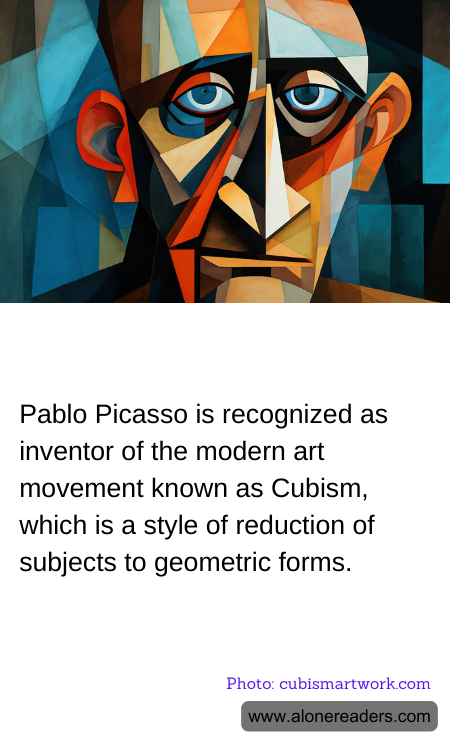
Pablo Picasso, a towering figure in the world of 20th-century art, is heralded for his pioneering role in the development of Cubism. This innovative art movement revolutionized the traditional approach to painting and sculpture, fundamentally altering how artists perceived and depicted the world around them. Cubism, co-founded by Picasso and his contemporary Georges Braque in the early 1900s, challenged the conventional forms of perspective that had dominated Renaissance art.
Cubism is characterized by its radical approach to form and perspective. Instead of portraying subjects from a single viewpoint, Picasso and his fellow cubists fractured their subjects into a multitude of geometric shapes and depicted them from multiple angles simultaneously. This allowed them to represent the subject in a broader context of time and space, giving the viewer a cumulative impression of the whole rather than a single, fixed viewpoint. The effects of this can be seen in works like "Les Demoiselles d'Avignon" (1907) and "Guernica" (1937), which not only play with form but also incorporate profound narratives of modernity and conflict.
While Cubism primarily began as an intellectual rebellion against artistic norms, it quickly evolved into a broader cultural movement. Its influence can be seen across various disciplines including literature, architecture, and music, where similar fragmentations and abstract representations were emerging. Key elements of Cubism like the collage technique, which involves creating composite artworks from an assemblage of different forms, also paved the way for future modernist experiments, influencing movements such as futurism, constructivism, and surrealism.
Moreover, Picasso's work within Cubism also helped to elevate the status of the artist from a mere craftsman to a thinker, fundamentally changing the societal view of the artist. His ability to convey complex political, social, and philosophical meaning through geometric abstraction has left a lasting legacy in the art world. Beyond just an art form, Cubism became a critical tool for exploring the modern experience, showcasing how profoundly the visual language can influence perception and thought.
In summary, Picasso's development of Cubism was more than an artistic breakthrough; it was a turning point that reflected the complex transformations of the 20th century. His innovative approach to seeing and representing the world has opened endless possibilities in art and remains a central study in the discourse of modern and contemporary art. Through his work, Picasso didn't just change art—he also changed how we understand the world around us.
