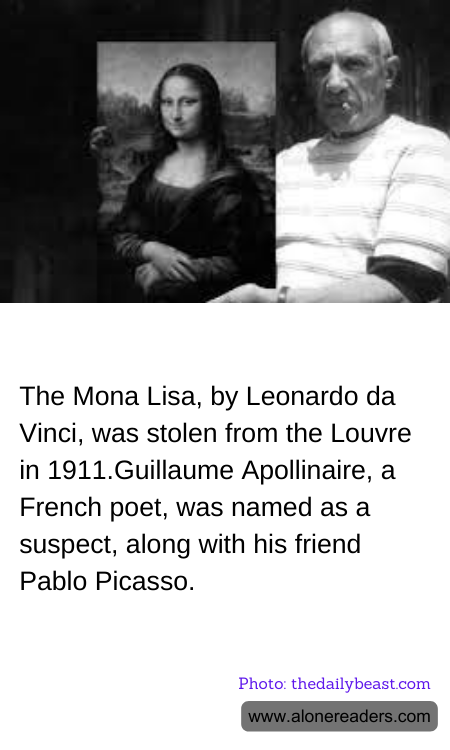
The Mona Lisa, Leonardo da Vinci's masterpiece, has captivated viewers with its enigmatic smile for centuries. However, in 1911, this iconic painting became the focus of a sensational criminal case when it was stolen from the Louvre in Paris. The audacious theft, carried out by an Italian handyman named Vincenzo Peruggia, not only shocked the art world but also led to an intriguing investigation involving some prominent figures of the time.
Peruggia, who had previously worked at the museum, managed to remove the painting from its frame and walk out with it hidden under his clothing. The theft was not discovered until the following day, as the museum was closed for maintenance on Monday, allowing Peruggia ample time to make his escape. His motive, as revealed later, was a misguided attempt to return the painting to Italy, believing it had been stolen by Napoleon during the French invasions.
The investigation into the disappearance of the Mona Lisa took an unexpected turn when the police began to suspect figures within the Parisian avant-garde art community. Among those were Guillaume Apollinaire, a well-known French poet, and his friend Pablo Picasso, the famed Spanish painter. Apollinaire was arrested and briefly jailed in September 1911. The poet had once advocated stealing Louvre paintings to reclaim them for Italy and had received some stolen Iberian statues from Peruggia, which eventually ended up in Picasso’s studio.
Picasso was also brought in for questioning, as suspicions arose about his possible involvement in art thefts. Both Apollinaire and Picasso were deeply entangled in the bohemian and often tumultuous art scene of Montmartre, which fueled speculations about their roles in the crime. However, no substantial evidence could link either of them directly to the theft of the Mona Lisa, and both were eventually exonerated.
The Mona Lisa remained missing for over two years and was thought lost forever until December 1913 when Peruggia attempted to sell it to the Uffizi Gallery in Florence. His arrest followed shortly, and the painting was returned to the Louvre in January 1914. Peruggia served a brief jail sentence, his act having been partly motivated by nationalistic sentiments.
The theft brought unprecedented attention to the Mona Lisa, elevating its status as one of the most famous and instantly recognizable paintings in the world. Meanwhile, the brief accusation against figures like Apollinaire and Picasso adds a curious footnote to the history of the artwork, intertwining it with the lives of other key artists of the 20th century, blending fact with legend in the narrative of the art world's most mysterious theft.
