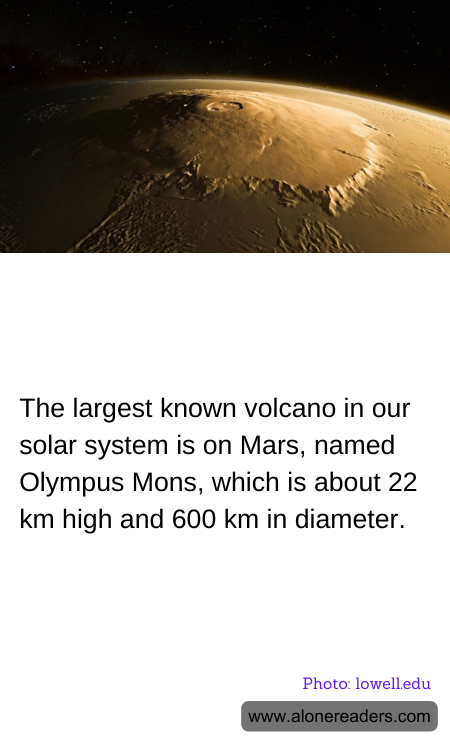
Olympus Mons, towering at roughly 22 kilometers in height and spanning 600 kilometers in diameter, holds the title of the largest known volcano not only on Mars but in our entire solar system. This colossal shield volcano, composed primarily of basalt, has dimensions that surpass any terrestrial volcano, standing nearly three times the height of Mount Everest. The size of Olympus Mons is so immense that the volcano's base could cover the entire state of New Mexico.
The formation of Olympus Mons is attributed to the unique Martian geology. Mars lacks the type of tectonic plate activity that reshapes Earth's landscape, allowing volcanoes to pour lava from a single point over geological time scales. The continuous lava flow, layering upon itself, has given rise to the towering height and expansive base of Olympus Mons. Furthermore, Mars' lower surface gravity, about 38% of Earth's, contributes to the potential for forming larger geological structures, as the weaker gravitational pull allows material to stack up higher.
Olympus Mons is not just a marvel in terms of size but also in age. Geologists have determined that volcanic activity at this site could have been ongoing for over 200 million years. This long duration of activity is rare compared to Earth's more rapidly shifting geological scenery. The slopes of Olympus Mons are gentle, a typical characteristic of shield volcanoes, which are built almost entirely of fluid lava flows. The volcano's caldera, the large depression at the summit, is about 80 kilometers wide and several kilometers deep, comprised of six overlapping pit craters.
Exploring Olympus Mons and other Martian volcanoes offers scientists valuable insights into the volcanic activity and geological history of Mars. Observations and samples could reveal clues about Mars' past climate conditions, including whether conditions might once have supported life. As humanity plans more missions to Mars, Olympus Mons could serve as a compelling target for research, potentially holding answers to the ancient mysteries locked within the Red Planet's crust.
