The Burj Khalifa, a marvel of modern engineering and architecture, stands as a testament to human ingenuity and the capabilities of contemporary construction technologies. With its staggering height of 828 meters, it's not just the world's tallest building but also a symbol of the grand ambitions of Dubai, United Arab Emirates. Constructed with more than 330,000 cubic meters of concrete, the Burj Khalifa's scale is difficult to grasp. This amount of concrete is enough to lay a sidewalk that would stretch over 2,000 kilometers, roughly the distance from Dublin to Moscow.
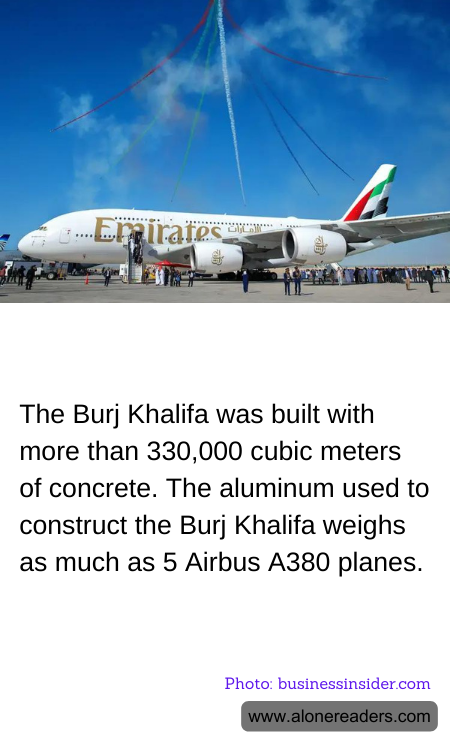
Moreover, the aluminum used in the building of the tower weighs as much as five Airbus A380 aircraft, the world's largest passenger airliner. This comparison highlights not just the scale, but also the complexity and the challenges involved in the skyscraper’s construction. Indeed, the use of such vast quantities of aluminum and concrete was critical in achieving not just the incredible height of the Burj Khalifa but also its structural integrity and wind resistance.
The Burj Khalifa's design and construction required innovative approaches and solutions. For instance, the Y-shaped floor plan and spiraled silhouette are designed to reduce the wind forces on the building, while the stepped design allows for a modular and efficient repetition in construction. The construction of the Burj Khalifa was a global effort, involving more than 30 contracting companies from around the world, which showcases the building as not only an architectural and engineering feat but also a symbol of global cooperation.
The sustainable features of the building, such as the condensation collection system which harnesses water from the humid Dubai air, demonstrate a commitment to environmentally conscious design. This system provides about 15 million gallons of supplemental water per year, enough for 20 Olympic-sized swimming pools.
Ultimately, the Burj Khalifa is more than just a set of impressive statistics; it is a cultural landmark and a pinnacle of architectural thought that pushes the boundaries of what is achievable in skyscraper design and construction.
