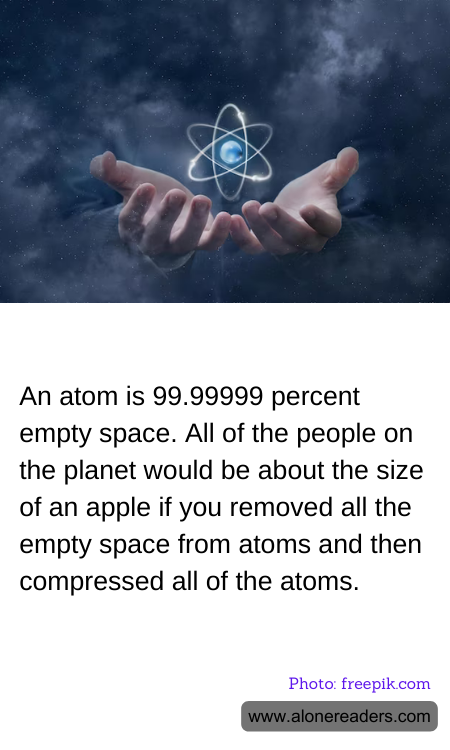
The nature of atoms as being almost entirely empty space is a concept that challenges our everyday perceptions of physical matter. An atom comprises a tiny nucleus surrounded by electrons that orbit at relatively vast distances, given the scale at which atoms operate. The nucleus, which contains the protons and neutrons, makes up a minuscule portion of the atom's volume, with the electrons, which are almost negligible in mass, zipping around in this mostly empty space. The vast spaces between the nucleus and the electron clouds are what contribute to the atom being 99.99999 percent empty space.
This realization leads to some mind-boggling implications when scaled up to objects and organisms composed of countless atoms, including humans. For example, if it were possible to remove all the empty space within the atoms that make up all the human beings on Earth, the mass of the Earth's entire population would compress down to about the volume of a standard apple. This stark disproportion arises because, while atoms themselves are mostly empty space, they construct matter in such a way that this space isn’t usually perceptible, giving objects and living things their size, shape, and mass as we typically understand them.
This concept isn’t just a playful thought experiment; it underscores fundamental principles of physics and chemistry. It highlights how forces like electromagnetism play a pivotal role in shaping the physical world. The electron cloud and the nuclear core are bound by electromagnetic forces, preventing the electrons from spiraling into the nucleus and maintaining the atom's structure. This arrangement dictates the interactions between atoms, influencing everything from chemical reactions to the solidity, texture, and form of objects—even our own physical existence.
Understanding this atomic emptiness also feeds into broader scientific endeavors. For instance, in fields like material science, knowing how atoms are spaced and how they interact can lead to the development of stronger, lighter, or more flexible materials. It also has implications in understanding the universe at large. The surprising amount of empty space within atoms across all matter influences everything from the properties of stars to the feasibility of traversing vast interstellar distances.
In conclusion, the empty space in atoms is a fundamental characteristic of the universe, dictating not just the scale and structure of matter, but also the very properties and behaviors of everything we can observe and interact with. This understanding pushes the boundaries of science, technology, and even our philosophical ruminations about the nature of reality.
