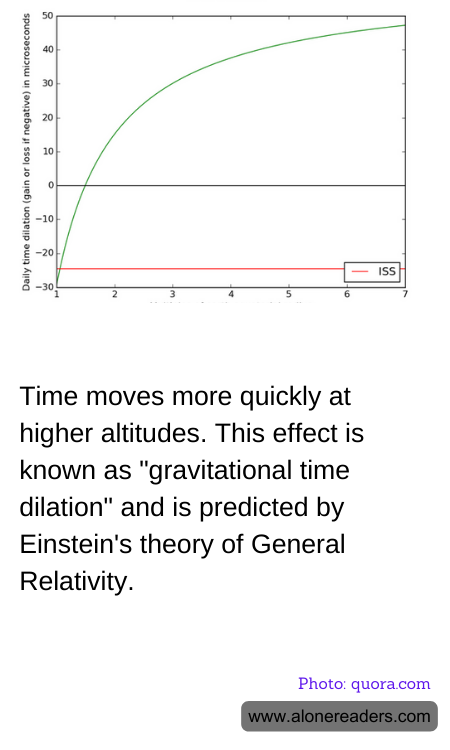
The concept of time moving more quickly at higher altitudes is a fascinating aspect of Albert Einstein's theory of General Relativity. This phenomenon, known as gravitational time dilation, suggests that time passes at different rates depending on the strength of a gravitational field. In simple terms, the closer you are to a massive object, like the Earth, the slower time passes. Conversely, as you move away from Earth’s surface - toward higher altitudes - time actually speeds up slightly because the gravitational pull is weaker.
Einstein's equations of General Relativity explain that what we perceive as the force of gravity actually arises from the bending of space and time by masses. Every object with mass warps the fabric of space-time, creating what we experience as gravity. Time dilation occurs because this warping affects the passage of time. Clocks placed at lower potentials in a gravitational field (closer to a mass) tick slower compared to those located at higher potentials.
This is importantly confirmed by practical experiments. For instance, precise atomic clocks at different altitudes have shown measurable differences in elapsed time. In a famous experiment, one atomic clock was flown around the world on an airplane (thus experiencing a weaker gravitational field than a similar clock on the ground), and after the flight, there was a slight discrepancy between the two clocks – just as General Relativity predicted.
The effects of gravitational time dilation are imperceptible to humans in everyday life, as the variations are minuscule at the differences in altitude we typically experience. However, they have crucial applications in technology. For example, the Global Positioning System (GPS) needs to account for time dilation effects; otherwise, the location determinations would be significantly off. Both the satellites in orbit, which are in a weaker gravitational field compared to devices on Earth's surface, and their moving speeds contribute to time dilation that must be corrected for precise navigational calculations.
Thus, gravitational time dilation not only proves a fundamental aspect of the universe as described by General Relativity but also influences the functionality of modern technology, intertwining the realms of theoretical physics and practical application. Through these insights, we can appreciate how deeply intertwined space, time, and gravity are in shaping our understanding of the universe.
