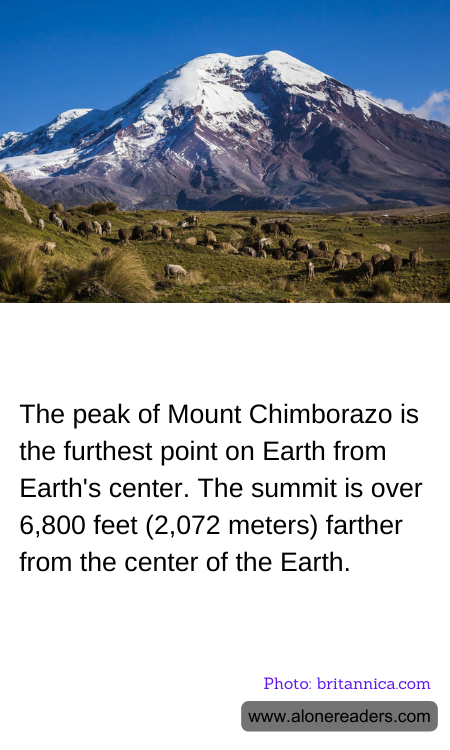
Mount Chimborazo, an inactive stratovolcano in the Cordillera Occidental range of the Andes, Ecuador, holds a unique distinction in planetary geography. Despite not being the highest mountain by elevation above sea level, Chimborazo's summit is the furthest point from the Earth's center. This geological anomaly arises from the mountain's location near the equator and the equatorial bulge of the planet.
The Earth is not a perfect sphere but an oblate spheroid, slightly flattened at the poles and bulging at the equator due to its rotation. Mount Chimborazo sits just one degree south of the equator, where the Earth’s radius is at its maximum. This equatorial bulge means that Chimborazo's peak, despite being 6,263 meters (20,549 feet) above sea level, is about 6,800 feet (2,072 meters) farther from the center of the Earth than the summit of Mount Everest. Everest, at 8,848 meters (29,029 feet), is the highest mountain above sea level but is located far from the equator where the Earth's radius is smaller.
The significance of Mount Chimborazo extends beyond its geographical attributes. It has become a symbolic figure in illustrating the complexity and irregularity of Earth's shape. It challenges the conventional measures of mountain height, which typically focus only on elevation above sea level, instead of considering the true "high points" in relation to the center of the Earth.
This distinction played a vital role in historical scientific studies as well. French geodesist Pierre Bouguer and the Ecuadorian-born geographer, La Condamine, who first measured Chimborazo in the 1740s, used its unique position to conduct experiments that helped to confirm that the Earth is indeed an oblate spheroid. These early scientific endeavors were pivotal in enhancing our understanding of the Earth's shape and gravitational field.
For travelers and climbers, Mount Chimborazo offers a unique allure. Reaching its summit is not just about overcoming a mountaineering challenge but also about standing on a spot that is, in a very real sense, closer to outer space than the top of Mount Everest. This fascinating aspect of Chimborazo adds a special significance to their ascent, blending the thrill of adventure with a touch of cosmic peculiarity.
Thus, Mount Chimborazo in the beautiful ranges of the Andes stands not only as a testament to Earth's geographical diversity but also as a beacon for scientific discovery and adventure, symbolizing how even lesser-known peaks can hold titles that challenge and expand our understanding of our planet.
