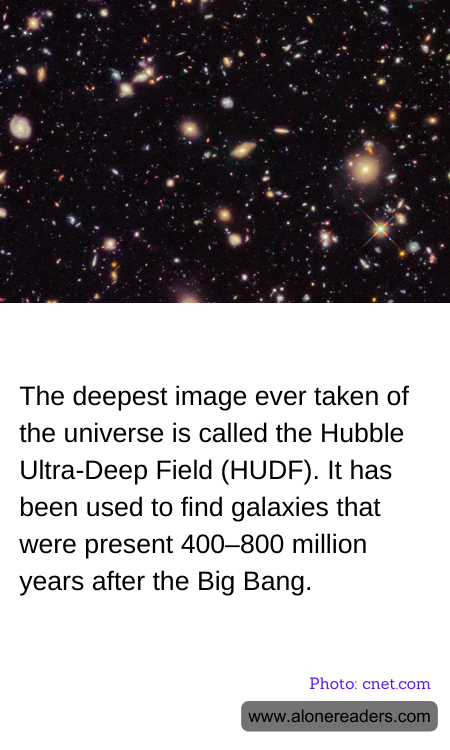
The Hubble Ultra-Deep Field (HUDF) stands as a pinnacle achievement in the exploration of the cosmos, capturing an image that provides a profound glimpse into the early stages of the universe. This monumental image was taken using the Hubble Space Telescope, which has been in operation since 1990 and serves as one of humanity's primary windows into the vast expanse of space.
The HUDF image is renowned for its depth and clarity, revealing galaxies that are billions of light-years away. Captured after hundreds of hours of observation time from September 2003 to January 2004, it encompasses a tiny patch of sky in the constellation Fornax, yet it reveals some 10,000 galaxies, some of which are seen as they existed just 400 to 800 million years after the Big Bang.
This profound timeframe, situated less than a billion years after the universe's inception, is crucial in understanding the formation and evolution of galaxies. The light from these galaxies has traveled across vast cosmic distances, reaching Earth after billions of years. This means that astrophysicists are looking back in time, observing the galaxies not as they are today, but as they were in the distant past, offering a form of cosmic time travel that provides invaluable insights into the early universe.
The galaxies observed in the HUDF exhibit a variety of shapes, sizes, and colors, reflecting different stages of evolution. Some appear small and compact, indicative of young galaxies in the process of forming their first stars. Others are larger and more fully formed, showing signs of significant star activity. The variety and number of galaxies visible in the HUDF provide a statistical sample that is critical for testing theories of galaxy formation and evolution.
Moreover, the depth of the HUDF also allows astronomers to test the properties of dark matter and dark energy, two of the most mysterious components of the universe. By observing how the light from distant galaxies is bent and distorted as it passes through dark matter, astronomers can map these unseen structures and better understand how they influence the growth and formation of galaxies.
Overall, the Hubble Ultra-Deep Field image is not just a photograph; it's a comprehensive, deep-time archive of the universe's history, holding clues to the grand-scale structure of the cosmos and the processes that have dominated its evolution. It is a fundamental resource that will continue to be studied for decades, continually revealing new insights about our universe's mysterious and dynamic nature.
