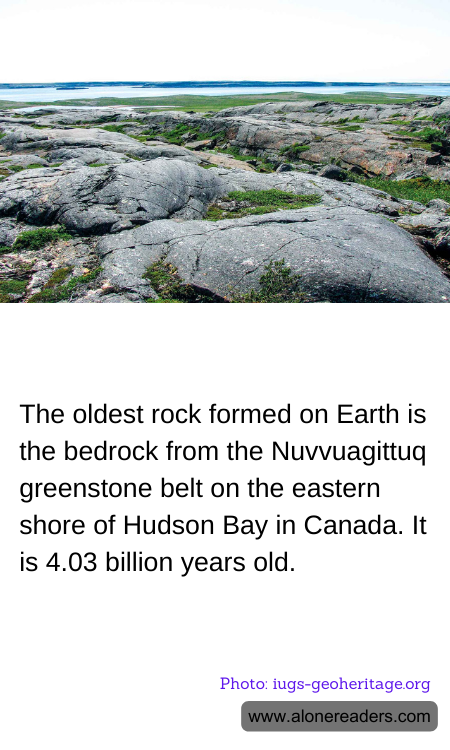
The Nuvvuagittuq greenstone belt, situated on the eastern shores of Hudson Bay in northern Quebec, Canada, is home to some of the oldest known rocks on Earth. These ancient rocks have been dated to be 4.03 billion years old, providing a rare and invaluable window into the early history of our planet. Geologists and researchers are particularly interested in this area as it holds clues to the conditions and processes that were present on Earth more than four billion years ago.
The rocks of the Nuvvuagittuq greenstone belt are predominantly formed from volcanic processes and are considered to be remnants of the Earth's early crust. The formation of these rocks is closely linked to the processes that led to the development of continents and the stabilization of the Earth's crust. Studying the isotopic and chemical composition of these rocks allows scientists to gain insights into the early Earth's atmosphere, ocean chemistry, and the beginnings of continental crust formation.
The discovery and dating of the rocks in the Nuvvuagittuq greenstone belt have significant implications for understanding the geological time scale and the evolution of the Earth. By examining these ancient materials, scientists can refine the timeline of events that shaped our planet, from the cooling of Earth's magma ocean to the emergence of life.
Furthermore, the study of these ancient rocks also challenges and enhances our understanding of plate tectonics and the dynamic processes that have continuously reshaped the Earth's surface. As researchers continue to explore and analyze the Nuvvuagittuq rocks, they not only unravel the mysteries of Earth’s formative years but also deepen our understanding of other celestial bodies, offering comparative insights that might apply to the study of other planets in our solar system and beyond.
In conclusion, the Nuvvuagittuq greenstone belt and its ancient rocks not only act as a record of Earth's primordial conditions but also as a cornerstone for multidisciplinary scientific research, fostering advancements in geology, chemistry, astrobiology, and Earth sciences at large.
