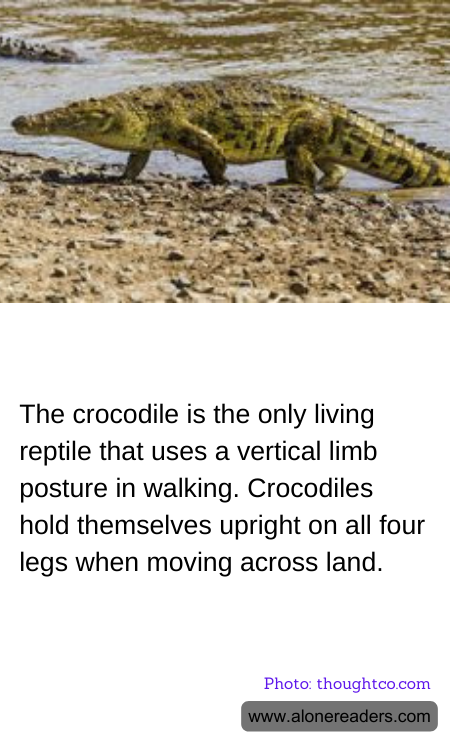
The crocodile, a member of the order Crocodylia, boasts a unique adaptation among living reptiles: a vertical limb posture during terrestrial locomotion. Unlike other reptiles that typically have a sprawling gate, crocodiles hold themselves upright on all four legs, resembling the stance more commonly seen in mammals. This posture provides several mechanical and physiological advantages.
Firstly, by elevating the body off the ground, crocodiles reduce frictional resistance during movement, allowing for more efficient land travel. This is particularly beneficial as it conserves energy during long journeys between water bodies or during overland hunts. Additionally, the elevated posture helps keep the body clear of hot surfaces, which is crucial for temperature regulation in their often warm, sun-drenched habitats.
Another aspect of the crocodile’s upright stance is its galloping capability. Unique among extant reptiles, some species of crocodiles, like the Australian freshwater crocodile, can gallop and even leap using their powerful limbs. This burst of speed is vital during predator evasion or when capturing fast-moving prey.
The skeletal structure of crocodiles also supports their vertical limb posture. Their robust limbs are well-suited to support the animal's weight, enabling these large predators to support their heavy, muscular bodies while walking or even running on land.
This mode of locomotion is more reminiscent of the way some extinct reptiles, such as dinosaurs, moved, suggesting an interesting evolutionary parallel within Archosauria, the clade that includes both crocodiles and dinosaurs. Research into crocodile locomotion not only helps in understanding their ecological roles today but also provides insights into the biomechanics of other similar vertebrates, both living and extinct.
Despite these advantages, crocodiles remain primarily aquatic animals and are far more agile in water. Their upright land locomotion, while effective for short bursts, is not suited for long-distance travel. In water, their streamlined bodies and powerful tails allow them to swim swiftly and maneuver effectively, an adaptation that is critical to their survival as ambush predators.
In conclusion, the crocodile's use of a vertical limb posture is a fascinating example of evolutionary adaptation that supports mobility across different environments. Their ability to modify traditional reptilian sprawling to something more efficient represents a remarkable aspect of their behavior and physiology, contributing significantly to their success as predators in diverse aquatic and terrestrial ecosystems.
