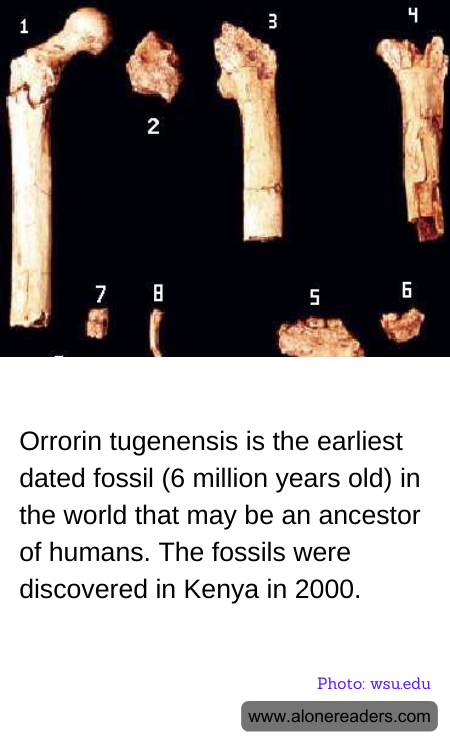
Orrorin tugenensis, discovered in 2000 in the Tugen Hills of Kenya, represents one of the oldest known potential ancestors to humans, with an age of about 6 million years. This find is crucial in the study of human evolution, potentially rewriting the timeline and mapping out early human ancestors more distinctly than ever before.
The discovery of Orrorin tugenensis was significant because its features seem to suggest that it was bipedal, indicating that walking on two legs might have occurred much earlier in the evolutionary timeline than previously theorized. The debate is ongoing, however, because some of the characteristics also share similarities with those of non-bipedal primates. The dental morphology and jaw structure in particular suggest dietary adaptations that align closely with later hominins, perhaps indicating a diet that included a mix of tough foods and fruits, similar to modern humans'.
The size and shape of the femur and other limb bones imply that Orrorin tugenensis could walk upright but might also have been adept at climbing. This adaptation would have offered numerous advantages, such as scouting for predators and gathering food, which are considered pivotal in the course of human evolution. The partial nature of the fossil record, however, makes it challenging to definitively conclude the degree of bipedalism in Orrorin.
Moreover, this discovery opens up further questions about the environment these early humans lived in and how that environment shaped their evolution. Given their age, they lived during the late Miocene, a period about which there is still much to learn, especially concerning climate conditions and ecological systems. The characteristics of the surrounding area, from the types of available food sources to the presence of natural shelters and predators, would have had significant influences on their development and survival strategies.
In the broader context of paleoanthropology, the study of Orrorin tugenensis provides valuable insights into the diversity and adaptability of early hominins. It also challenges and perhaps encourages a reevaluation of other finds such as Ardipithecus ramidus and Australopithecus afarensis, helping scientists piece together the complex puzzle of human evolution. Each discovery like Orrorin adds layers to our understanding of how ancient environments shaped the path from primitive ape-like creatures to modern humans, underlining the importance of continual research and exploration in these ancient sediments.
