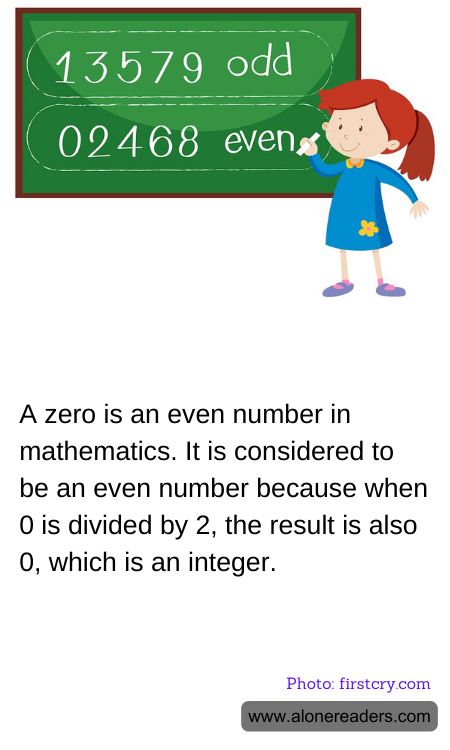
In the realm of mathematics, the concept of even and odd numbers is fundamental, especially when classifying integers. An even number is defined as any integer that can be divided by two without leaving a remainder. Typically, when thinking of even numbers, integers like 2, 4, 6, and so on come to mind. However, zero (0) is also classified as an even number, a fact that sometimes surprises those new to number properties.
The classification of zero as an even number is based on the same rule that applies to all even numbers. Specifically, a number is even if it can be written in the form of 2n, where n is an integer. In the case of zero, it can be expressed as 2 times 0, which indeed results in zero, satisfying the even number condition. This definition holds consistently across arithmetic, where the divisibility test determines a number's classification as even or odd.
Moreover, zero's status as an even number is not merely a trivial fact; it has practical implications in various fields of mathematics and computer science. For example, in the world of algorithms and programming, understanding that zero is even can affect how code is written and how functions behave in specific scenarios concerning iteration and data sorting.
Understanding that zero is even also aids in grasping the symmetry and properties of the integer number line, where zero acts as a central pivot point from which positive and negative integers extend. This understanding is crucial in fields like number theory and algebra, where the properties of integers are often explored in depth.
Overall, zero’s classification as an even number is aligned with the mathematical rules and principles that govern the classification of numbers. This consistent approach not only makes calculations and categorizations straightforward but also helps maintain clarity and uniformity in mathematical reasoning and applications.
