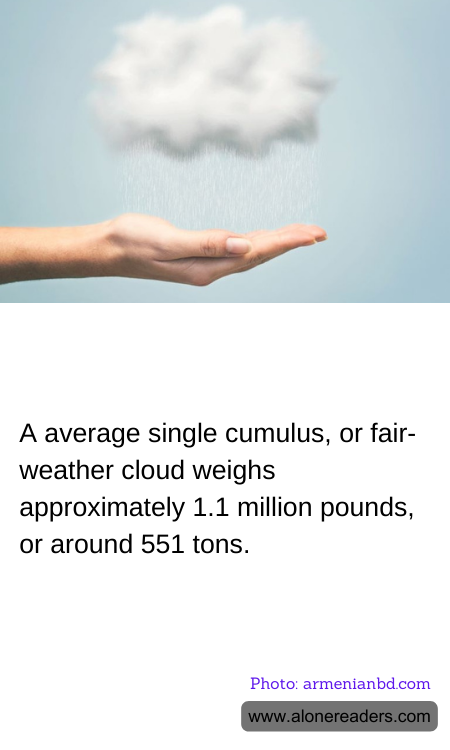
Clouds, those fluffy, floating objects in the sky, may appear light and airy, but they carry a significant weight. An average cumulus cloud, also known as a fair-weather cloud, weighs approximately 1.1 million pounds or around 551 tons. This weight is derived from the water droplets and ice crystals that make up their structure, amassed across vast volumes of sky.
To understand how something so heavy can float, it's necessary to understand the density and distribution of a cloud's mass. Clouds float because the density of the same volume of air is slightly greater than the density of the cloud, and the air beneath the cloud acts as a cushion keeping it aloft. These clouds form when warm air rises due to convection and cools as it ascends. As the air cools to its dew point, the moisture it carries condenses into minute water droplets or ice crystals, depending on the temperature. These tiny particles group together to form a cloud.
The idea that such a massive object can drift effortlessly across the sky is a fantastic illustration of the wonders of physics and atmospheric science. Each cloud, while massive, is spread over such a large area that its overall density is low, allowing it to remain suspended. This phenomenon highlights the intricate balance within Earth's atmospheric conditions.
Moreover, the weight of a cloud is a reminder of the sheer volume of water continuously cycling through our environment, contributing significantly to weather patterns and the earth’s climate. These water cycles in the form of precipitation, condensation, and evaporation are vital for maintaining life on Earth. Hence, even a seemingly mundane fair-weather cloud plays a critical role in our daily weather and the broader climate system, holding not just physical weight but also substantial environmental significance.
