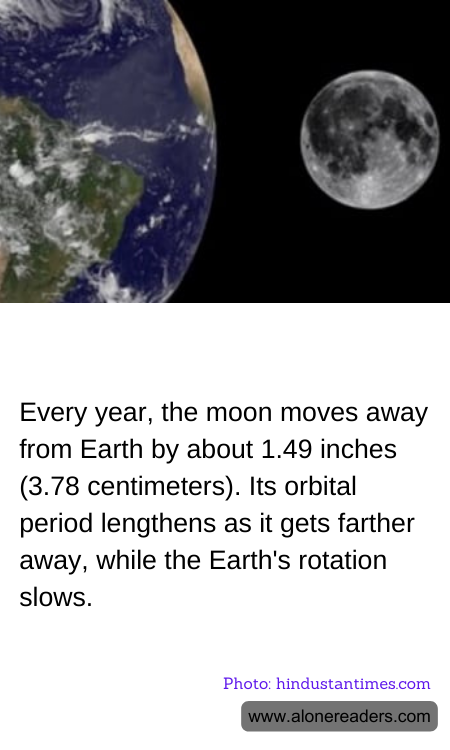
The moon's gradual drift away from Earth is a phenomenon that has intrigued astronomers and scientists for decades. Each year, the moon orbits Earth at a distance that increases by approximately 1.49 inches (3.78 centimeters), a slow but steady migration that has significant long-term implications for our planet. This incremental movement is primarily due to the tidal forces acting between the Earth and the moon. These forces generate tidal bulges on Earth, which the moon's gravity pulls on, creating a torque that pushes the moon to a higher orbit.
As the moon inches farther away, its orbital period— the time it takes to complete one orbit around Earth—also lengthens. Currently, it takes the moon about 27.3 days to orbit Earth, but this duration is slowly increasing. As the moon's distance increases, the gravitational pull it exerts on Earth weakens slightly, which contributes to changes in the orbital dynamics.
Simultaneously, Earth's rotation is slowing down, a process linked to the same tidal forces causing the moon to recede. The energy lost due to the tidal interactions with the moon adds up over time, leading to a longer terrestrial day. Presently, this slowdown is adding about 1.7 milliseconds to the length of a day each century, though this rate has varied throughout geological history.
The consequences of these changes are subtle but profound. Billions of years in the future, these dynamics will lead to noticeably longer days on Earth and a more distant moon, which could affect everything from the planet's climate to the way species, including humans, perceive time. The slowing of Earth's rotation and the moon's recession are also crucial in studying the past dynamics of our planet-moon system, providing insights into how celestial mechanics have shaped the Earth's environment over millennia.
Understanding these intricate celestial mechanics helps scientists predict future changes and provides crucial insights into the dynamic and ever-evolving nature of our planet and its lunar companion. While these changes are minute in the scale of human lifetimes, their cumulative effect over millions or billions of years holds significant implications for Earth and its natural systems.
