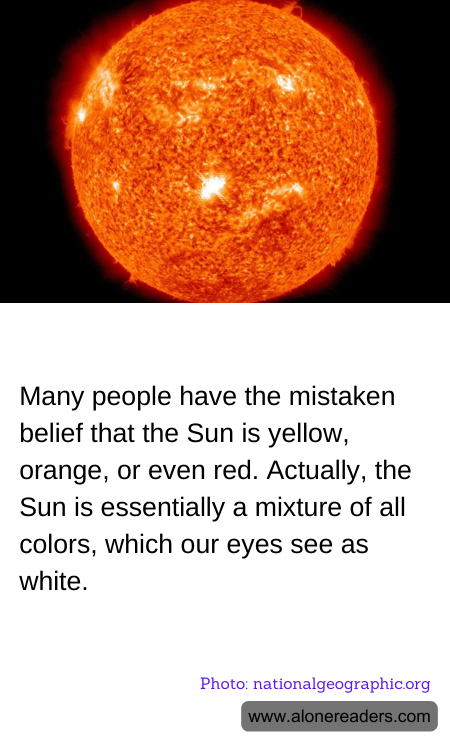
When one imagines the Sun, they often picture it as a vibrant yellow, orange, or even a fiery red orb hanging in the sky. This portrayal has been reinforced by countless paintings, illustrations, and everyday observations of sunrises and sunsets. However, this common perception does not accurately reflect the true color of the Sun.
Scientifically, the Sun is essentially a white star. The misconception about its color arises from the way its light interacts with the Earth's atmosphere. The Sun emits electromagnetic radiation across a wide range of wavelengths, and when combined, this spectrum of colors actually appears white to the human eye. This is because the Sun’s surface temperature is about 5,500 degrees Celsius (about 9,932 degrees Fahrenheit), causing it to emit light strongly across the entire visible spectrum.
When we observe the Sun at sunrise or sunset, the situation changes, and it appears more red or orange. This phenomenon is due to the Earth’s atmosphere acting like a filter. During sunrise and sunset, sunlight has to pass through a greater amount of the Earth’s atmosphere compared to when the Sun is high in the sky. The atmosphere scatters shorter wavelength colors, like blue and green, more than the longer wavelengths such as red and orange. Consequently, the predominant colors that come through are in the red and orange spectrum, giving the Sun its warm, glowing hue during these times.
Interestingly, astronauts who have observed the Sun from space, where there is no atmosphere to scatter the light, report that it indeed looks white – a perfect demonstration of its true intrinsic color. This observation also aligns with what we know about the Sun’s spectrum from scientific studies.
In conclusion, the Sun, despite popular depictions and daily experiences influenced by atmospheric effects, is a white star. The myriad colors including yellows, oranges, and reds typically associated with depictions of the Sun are the results of Earth's atmosphere scattering the shorter wavelengths and allowing the longer wavelengths to be more visible at certain times of the day.
