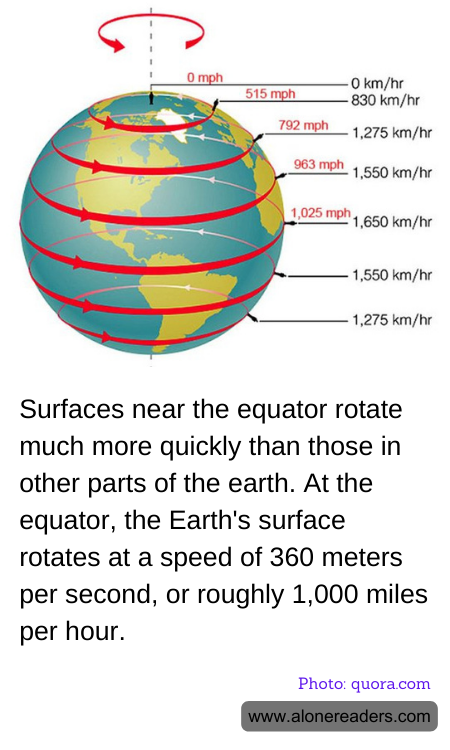
The rapid rotation of the Earth's surface at the equator compared to other latitudes is a fascinating aspect of our planet's dynamics. At the equater, the Earth’s circumference is greatest, measuring approximately 40,075 kilometers. Because each point on the surface must complete one full rotation around the Earth’s axis in 24 hours, equatorial regions travel at a staggering speed of about 1,670 kilometers per hour or about 1,040 miles per hour. This is significantly faster than the speed at which locations closer to the poles move.
This differential rotation speed arises because the Earth is an oblate spheroid, not a perfect sphere. It is slightly flattened at the poles and bulges at the equator. Consequently, while the rotational period (the time it takes for one complete spin) is the same for the whole planet – approximately 24 hours due to the constant angular velocity – the linear velocity varies depending on the latitude. The further from the equator, the shorter the distance a point travels in one rotation, and thus, the slower its linear velocity.
This variation in rotational speeds has several profound effects on various Earth processes and phenomena. For one, it influences atmospheric and oceanic circulations. The Coriolis effect, which is due to Earth’s rotation, causes moving air and water to turn right in the northern hemisphere and left in the southern hemisphere, creating weather patterns and ocean currents that vary with latitude. Additionally, the faster rotation at the equator contributes to the oblateness of Earth, which affects the gravity field of the planet.
Moreover, the greater centrifugal force at the equator, caused by the higher linear velocity, slightly counteracts the force of gravity, making objects weigh less at the equator than they would at the poles. This is also why the sea level at the equator stands slightly higher than at the poles.
Understanding these differences in rotational velocities is crucial for numerous practical applications, including satellite navigation and aerospace engineering, as well as for theoretical research in geophysics and meteorology. Indeed, the unique rotational dynamics of our planet play a crucial role in shaping the natural phenomena we observe and the environment we live in.
