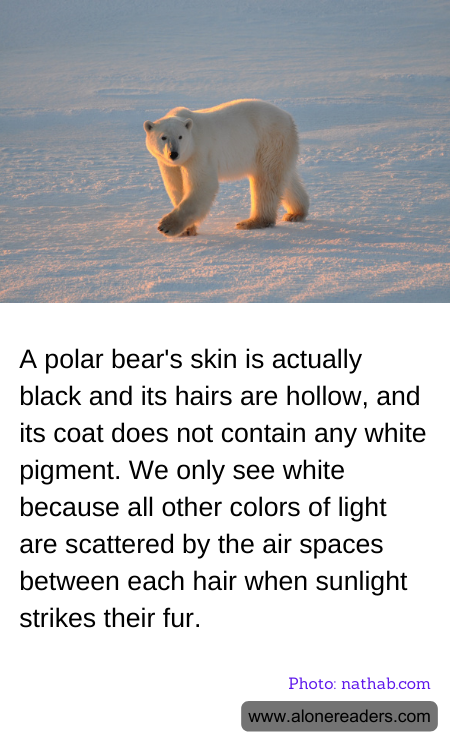
Despite their snowy white appearance, polar bears have black skin and their fur is actually translucent, not white. This unique adaptation has evolved over thousands of years to enable polar bears to blend seamlessly into their icy, Arctic environment, maximizing their effectiveness as predators and minimizing the risk of detection by prey. The black skin underneath the fur absorbs sunlight, helping these massive creatures to stay warm in the freezing temperatures of their habitat.
The hairs of a polar bear's coat are hollow, an extraordinary characteristic that aids in insulating these animals from the cold, while also helping in buoyancy when they swim. The hollow hairs trap air, providing thermal insulation, while also minimizing water absorption, enabling polar bears to swim long distances between ice floths or shores. Interestingly, this fur, despite its translucent nature, appears white due to the way light behaves when it strikes the fur.
When sunlight hits the polar bear’s fur, it enters the hollow hairs and bounces around due to the air spaces within each hair. This scattering of light occurs because the fur’s structure breaks down the light into individual spectrums. Since the fur does not have any pigment for color, and all colors continue to scatter, our eyes perceive the combination of scattered light as white. This optical illusion is crucial for their survival, as it camouflages them effectively against the predominantly white backdrop of snow and ice.
This distinctive fur not only serves as a perfect camouflage but also as a critical component of the polar bear's hunting strategy. Their ability to blend into their surroundings makes it easier for them to approach seals resting on the ice. The physical properties of their coat, coupled with their stealthy movement, make them formidable hunters, adapted perfectly to their harsh Arctic environment.
Understanding the unique characteristics of polar bear fur sheds light on the intricate ways in which animals adapt to their environments. It highlights the complex interplay between biology and physical phenomena like light, and underlines the fascinating aspects of evolutionary adaptation. This knowledge also underscores the importance of preserving such unique wildlife and their habitats, especially in the face of global climate changes that threaten their survival.
