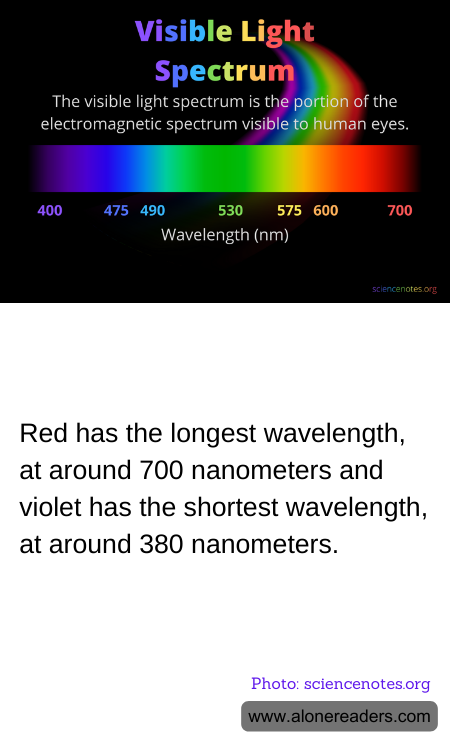
Red light, situated at one end of the visible spectrum, indeed has the longest wavelength of all visible colors, measuring around 700 nanometers. This long wavelength contributes to its distinct properties, such as its capability to travel long distances through atmospheric particles, which is why the sky at sunrise and sunset appears red. At the opposite end of the spectrum lies violet light, which has the shortest wavelength among the visible colors, approximately 380 nanometers. The shorter wavelength of violet allows it to carry more energy than red light.
The differences in wavelength across the spectrum are not merely a curiosity of physics but play a crucial role in various practical applications. For instance, because red light penetrates atmosphere and water with greater efficiency than shorter wavelengths, it is frequently used in applications that require transmission over long distances, such as the tail lights of vehicles or in communication devices.
On the other hand, violet light's higher energy and shorter wavelength make it suitable for applications requiring precise energy delivery on very small scales, such as in optical data storage and the disinfection of water. Violet LEDs are often used in devices that sterilize water and surfaces, destroying harmful bacteria and viruses more effectively than other wavelengths.
Moreover, the spectrum of visible light is instrumental in the field of astronomy for identifying the chemical composition of stars and other celestial bodies. Astronomers analyze the light emitted or absorbed by an object in space to determine its makeup, temperature, density, and motion. Each element in the universe emits light at specific wavelengths, and by observing these, scientists can gather detailed information about distant stars and galaxies.
In the arts and design, understanding the properties of different wavelengths can assist in creating visual effects and in color psychology. The longer wavelengths of red can evoke feelings of warmth and alertness, making it a popular choice in spaces designed to stimulate interaction and communication, such as dining areas and living rooms. Conversely, the calm and soothing effect of violet is often utilized in environments meant for relaxation and contemplation, such as bedrooms and spas.
Overall, the physical properties of light across the color spectrum are not only fundamental to our understanding of optics but are also deeply interwoven with technology, science, and even cultural expressions.
