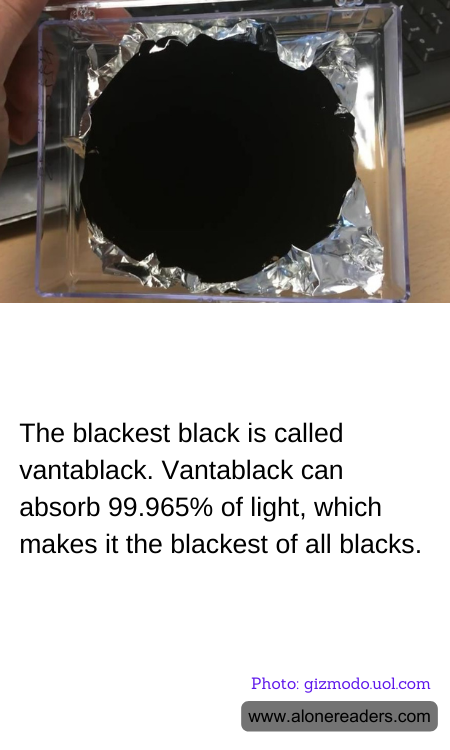
Vantablack, renowned for its status as one of the blackest known materials, has fascinated scientists, artists, and designers since its development. Created by Surrey NanoSystems in the United Kingdom in 2014, Vantablack is not a color but a material composed of vertically aligned carbon nanotube arrays (VANTA), which stands for Vertically Aligned NanoTube Arrays. This material is capable of absorbing a staggering 99.965% of visible light, a property that eliminates any visible features of an object it coats, rendering it into an abyss-like black void.
The ability of Vantablack to absorb light is so efficient due to the structure of the carbon nanotubes. Each nanotube is incredibly tiny—about 3,500 times smaller than a human hair—and tightly packed. When light strikes Vantablack, it becomes trapped and bounces around between the nanotubes until it dissipates as heat, making the material seem exceptionally dark and devoid of any sheen. This unique feature has numerous practical applications, including preventing stray light from entering telescopes, thus enhancing their sensitivity; improving thermal cameras and other optical imaging devices; and even potentially increasing the stealth capabilities of aircraft.
In addition to its scientific applications, Vantablack has also made a significant impact in the art and design worlds. It has been used in various artistic projects to create illusions of flatness and depth that challenge the viewer's perceptions of space and form. However, its use in art has not been without controversy, particularly when an exclusive license was given to an artist, restricting its use by others in the art world. This exclusivity sparked a debate about the ownership and accessibility of material technologies in artistic expressions.
Despite its fascinating properties, Vantablark is also not without its challenges. The material requires a specialized process for application, as the carbon nanotubes need to be grown in a controlled environment. Furthermore, its composition makes it extremely delicate and not very practical for some potential commercial uses without further modifications to enhance its durability.
As researchers continue to explore and develop new carbon nanomaterials, the future may hold even darker materials than Vantablark. These advancements might bring new opportunities and applications, though currently, Vantablack remains a singular marvel in the material sciences, a testament to the incredible capabilities of nanotechnology and its impact across various fields.
