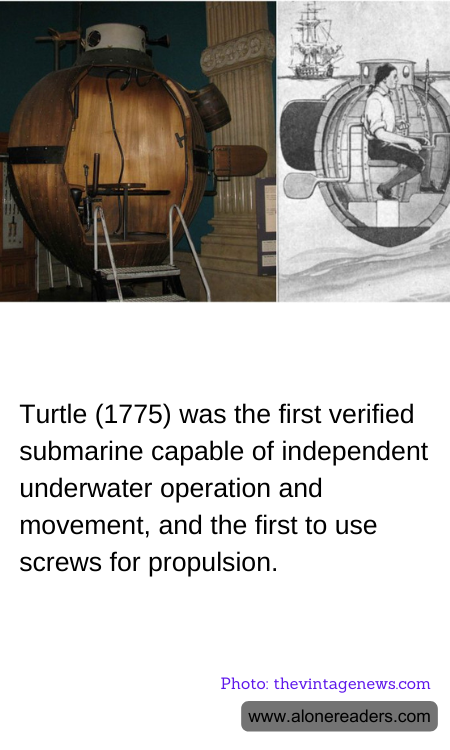
The Turtle, an iconic vessel in maritime history, holds the distinction of being the first verified submarine capable of independent underwater operation and movement. Launched in 1775 during the American Revolutionary War, the Turtle was designed by American inventor David Bushnell as a means to attack the British Royal Navy ships anchored in harbors. This pioneering submarine was constructed from wood and waterproofed with pitch, making it a groundbreaking piece of military technology at the time.
The Turtle was unique for several reasons, principally because of its method of propulsion. It was the first submarine to use screws for movement, which marked a significant departure from oared or towed underwater vessels of the past. The submarine was powered by a hand-cranked propeller, with the operator inside turning it to propel the vessel forwards or backwards. In addition to its propeller, the Turtle also featured a vertical screw that allowed the vessel to adjust its depth underwater, providing more precise control than ballast tanks used in earlier designs.
The shape of the Turtle was roughly egg-like, with enough interior space for one person. The operator sat inside the submarine, navigating by peering through a small glass window, with limited air supply that lasted about thirty minutes. This made lengthy operations underwater challenging, but it was sufficient for the short missions intended for the Turtle during the war.
Despite its innovative design, the Turtle had limited success in combat. Its most notable mission was an attempted attack on HMS Eagle, the flagship of the British fleet in New York Harbor. The plan was for the Turtle to approach the enemy ship unnoticed, drill into its hull, and attach an explosive charge. However, the mission was ultimately unsuccessful, partly because of the difficult water currents and the challenges of operating the submarine's complex systems.
Nevertheless, the Turtle set the stage for future submarine designs. It demonstrated that underwater naval operations were feasible, paving the way for more technologically advanced submarines that would come to play pivotal roles in naval warfare. The use of screw propulsion, in particular, would be refined and adopted in subsequent submarine and marine designs, long after the Turtle's initial voyage. Thus, the Turtle not only marks a significant point in U.S. naval history but also in the broader realm of maritime innovation, influencing submarine warfare and design for generations to come.
