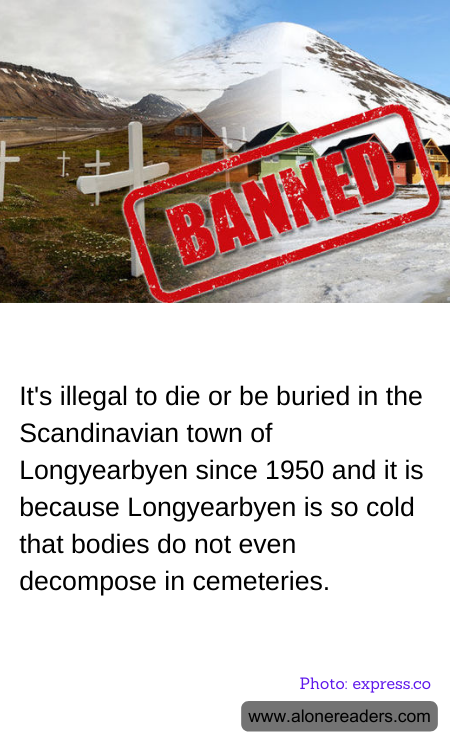
In the remote town of Longyearbyen, located in the Arctic archipelago of Svalbard, Norway, an unusual law exists: it is illegal to die there. Since 1950, locals and visitors alike have been confronted with this peculiar regulation. The genesis of the law traces back to extraordinarily practical concerns related to the region's frigid climate. Longyearbyen experiences such permanently cold temperatures that the permafrost preserves buried bodies almost perfectly, preventing them from decomposing.
The town discovered this chilling phenomenon when, in the 1930s, researchers were studying bodies that had been buried in the local cemetery decades earlier and found them to be remarkably well-preserved. This preservation poses a particularly modern concern, health risks, notably the possible resurfacing of the 1918 Spanish Flu virus, which some of the deceased carried. These viruses, preserved along with the bodies, potentially could be released into the environment as the permafrost slowly melts due to climate change.
Consequently, this law is enforced primarily for public health reasons. The government discourages any form of burial in the town and even has policies to deal with the inevitability of death. Residents who are terminally ill or elderly are transported to the mainland, where they can pass away naturally without posing a threat to the health of their community. In cases where death is sudden, the bodies are also transported to the mainland for burial.
This unique approach to dealing with death highlights how extreme environmental conditions can shape local laws and cultural practices in profound and sometimes unexpected ways. Longyearbyin's situation also opens up various discussions about the interaction between human settlements and the changing climate, raising questions about sustainable living in such vulnerable ecosystems. As the Arctic continues to warm, the implications of Longyearbyen's laws and its handling of such sensitive issues will likely serve as a case study for other regions facing similar ecological challenges.
