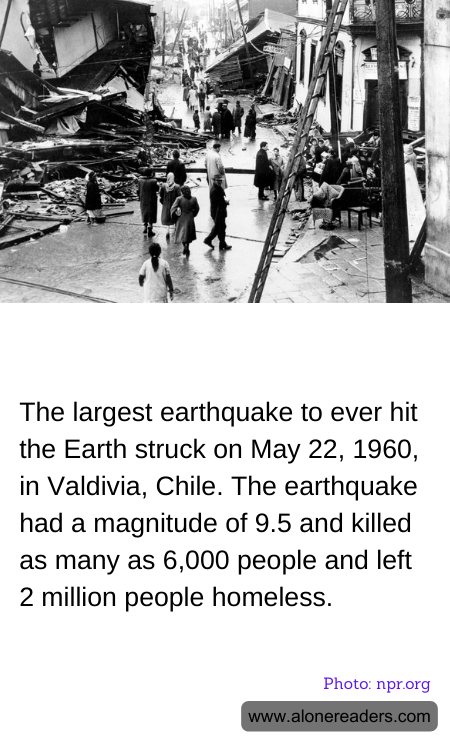
On May 22, 1960, the world experienced the most powerful earthquake ever recorded. The epicenter was near Valdivia, Chile, a quaint city surrounded by soft landscapes and forestry. Measuring an unprecedented magnitude of 9.5 on the Richter Scale, this earthquake has since been known as the Great Chilean Earthquake, or the 1960 Valdivia Earthquake. Its massive tremors caused significant devastation, leading to the tragic deaths of up to 6,000 people, with another 2 million finding themselves homeless in the aftermath.
The impact of the earthquake was so profound that it resulted in a series of natural disasters. The shaking led to landslides, which buried homes and infrastructure, compounding the catastrophe. In the coastal areas, the earthquake triggered monstrous tsunamis, which were responsible for severe damage and loss of life, not just in Chile, but as far away as Hawaii, Japan, the Philippines, and even the west coast of the United States. These tsunamis traveled across the Pacific Ocean, wreaking havoc and reminding the world of nature's formidable power.
Additionally, the earthquake caused the Riñihuazo, an unexpected phenomenon wherein the landslides created natural dams, trapping the waters of several rivers. The ensuing threat of flooding added another layer of crisis to the ongoing disaster relief efforts. It took weeks for these waters to stabilize, leaving the affected populations in a prolonged state of uncertainty and hardship.
The scale of destruction brought on by the 1960 Valdivia Earthquake catalyzed changes in how earthquakes were understood and managed. It underscored the need for better building codes, which are crucial in earthquake-prone regions. Chile, in response, reinforced its infrastructure and improved its emergency response strategies, setting a global example in seismic resilience.
Today, the Great Chilean Earthquake remains a poignant reminder of Earth's dynamic nature and the ever-present need for human societies to respect and adapt to this power. While it stands as a historic event marked by tragedy, it also represents a pivotal moment that has significantly influenced scientific research and policy development in earthquake readiness and response. The lessons learned continue to shape practices in seismology and disaster preparedness worldwide, ensuring communities are better equipped to safeguard against future seismic events.
