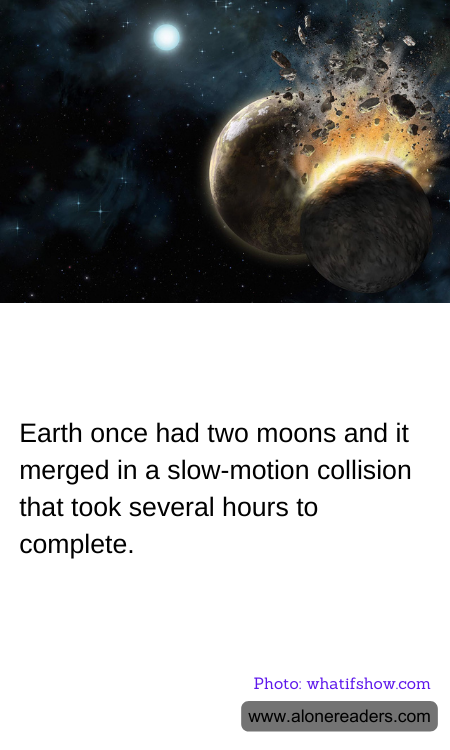
There's a captivating theory in planetary science suggesting that Earth once had two moons. According to this hypothesis, the moons existed in the formative years of our solar system and eventually merged in a colossal, slow-motion collision that had a profound impact on what we now see as our singular Moon. This event is thought to have occurred several billion years ago, not long after the Earth itself was formed.
The smaller companion moon is theorized to have been about one-third the size of the main moon we know today. The slow-motion collision, speculated to have lasted several hours, was unlike the violent impacts typically associated with cosmic events. Instead, it would have been a relatively gentle process, resulting in the two moons gradually fusing together. This explains why the far side of the Moon is so different from the side that faces Earth; it is heavily cratered and has a different composition, which might be residues from the smaller moon.
The merging of the two moons might have been triggered by gravitational forces. As the Earth and its moons interacted with the Sun and other planetary bodies, their orbits could have decayed or shifted, leading them to slowly spiral towards each other until they eventually collided. This hypothesis helps explain some of the Moon's mysteries, such as why its far side has a thicker crust and why there are discrepancies in the distribution of its minerals and elements.
Scientists continue to debate and research the two-moon theory, and there is much to be discovered about the early solar system from studying our Moon. Lunar missions and probes may provide more insight into the composition of the Moon, offering evidence that could either confirm or debunk the idea of a dual lunar past. If proven true, it would not only rewrite a chapter of Earth’s history but also enhance our understanding of planetary formation and the dynamic processes that shape moons and planets.
