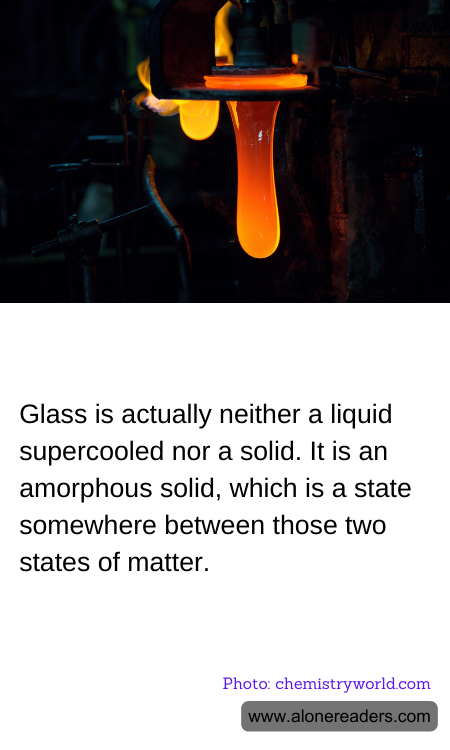
Glass, often mistaken for a liquid due to old myths surrounding window panes in antique buildings, is neither a conventional liquid nor a solid but is classified scientifically as an amorphous solid. This categorization reveals its unique internal structure and properties. Unlike crystalline solids, where molecules are arranged in a highly ordered structure, the molecules in an amorphous solid like glass are arranged randomly. This random arrangement prevents glass from having a distinct melting point and results in its brittle nature, shattering rather than deforming.
The confusion about glass being a liquid arises from observations of old glass windows that are thicker at the bottom. This phenomenon led many to believe that glass flows down very slowly over time. However, this irregularity is due to the glass-making methods used in the past, where the glass was not uniformly thick when installed. Modern scientific understanding confirms that the atomic structure of glass is rigid and does not flow at room temperature; thus, it does not change shape or thicken over time like a true liquid would.
Understanding the properties of glass as an amorphaceous solid helps in enhancing its applications. For example, because the disordered atomic structure of glass makes it transparent to visible light, it is ideal for use in windows and eyewear. Additionally, its resistance to biochemical reactions and its inability to absorb substances makes glass an excellent choice for use in various pharmaceutical and laboratory containers.
The study and categorization of glass as an amorphous solid, therefore, not only correct common misconceptions but also enhance the effectiveness with which this material is used across different industries, from architecture and automotive to scientific research and consumer products. The ongoing research into the properties of glass continues to push the boundaries of its application, making it one of the most versatile and essential materials in modern technology and everyday use.
