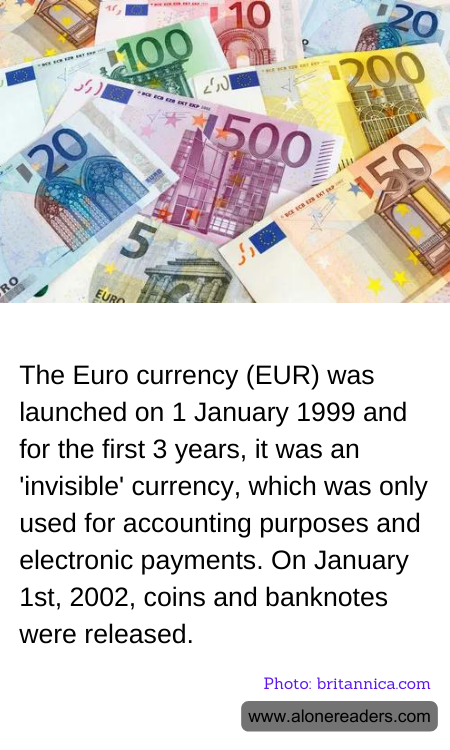
The introduction of the Euro currency (EUR) marked a significant milestone in the history of European economic integration. Having been launched on January 1, 1999, the Euro initially existed merely as a virtual currency for accounting and electronic transactions. This invisible phase was crucial as it provided a transitional period for the financial markets, banking institutions, and public administrations to adapt to the new currency without the logistical challenges associated with physical cash transitions.
During this initial period, transactions within certain financial and business sectors began to be denominated in Euros, although the national currencies of Eurozone countries continued to circulate and were used for everyday transactions. This duality allowed governments and businesses to stabilize the new currency's integration into the larger economic system, while minimizing financial disruption.
The physical manifestation of the Euro came on January 1, 2002, when Euro coins and banknotes officially entered circulation. The transition required considerable preparation, including the production and distribution of the new currency, and the recalibration of machines that handled money such as ATMs and vending machines. Public campaigns were rolled out across member states to educate citizens about their new currency, featuring information on the security measures of the banknotes, the exchange rate equivalents, and the visual characteristics of the coins and notes.
The introduction of the Euro has had significant economic, political, and psychological impacts on Europe. Economically, it facilitated a more seamless flow of trade and investment between member countries by removing the barrier of fluctuating exchange rates. Politically, it represented a profound commitment to the idea of a unified Europe, a symbol of integration and unity. Psychologically, whilst the transition provoked mixed reactions among Europeans, ranging from excitement and pride in some quarters to concern and skepticism in others, it indisputably marked a pivotal shift in the continent’s economic and social landscape.
Moreover, the Euro has become one of the world's leading currencies, used by millions daily and providing a counterbalance to the dominance of the US dollar in international financial markets. Its challenges, such as the Eurozone crisis, expose its vulnerabilities and the crucial need for economic coordination and stability among its member states. Yet, its success underscores its role not only as a financial instrument but also as a cornerstone of European identity.
