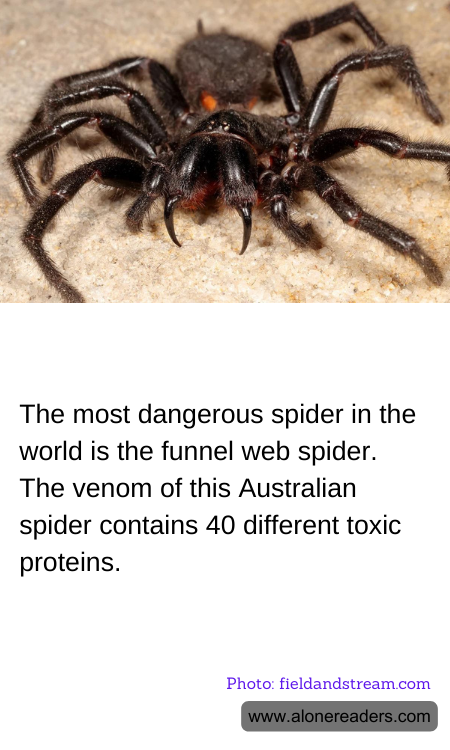
Found primarily in Australia, the funnel-web spider is often cited as one of the most dangerous spiders in the after. It is particularly notorious for its potent venom which is packed with no less than 40 toxic proteins, a fact that explains why its bite can be so harmful to humans. These proteins are capable of attacking the nervous system, causing severe biological reactions ranging from pain, muscle spasoms, to potentially life-threatening changes in blood pressure, and heart rate.
Among the various species of funnel-web spiders, the Sydney Funnel-Web (Atrax robustmay), which is predominantly found in Eastern Australia around Sydney, is particularly feared. It has become infamously associated with several serious spider bite incidents in its native range. The male Sydney Funnel-Web is regarded as especially dangerous due to its highly toxic venom which is more potent than that of its female counterpart.
The spider’s venom mechanism is efficient and stunning; once provoked, the funnel-web spider can deliver a bite that forcibly injects venom deep into the flesh. The physical characteristics of this spider, such as its large fangs which are larger than those of some snakes and capable of piercing through fingernails and soft shoes, make it all the more formidable.
Effective treatment for a funnel-web spider bite is crucial and must be prompt. Fortunately, since the development of antivenom in 1981, there have been no reported deaths due to funnel-web poisoning, demonstrating the importance of rapid medical intervention. Symptoms of a funnel-web spider bite can escalate quickly, and therefore, it is essential that anyone suspected of having been bitten receives medical attention immediately.
The fear of the funnel-web spider has had cultural and ecological implications in Australia, leading to public awareness campaigns and various precautionary measures being adopted by those living in or visiting the areas where these spiders are prevalent. Despite their fearsome reputation, funnel-web spiders play a natural role in their ecosystems, primarily feeding on insects, and contributing to the biodiversity of their habitats. Nevertheless, the potentially deadly nature of their bite makes them creatures deserving both respect and caution.
